

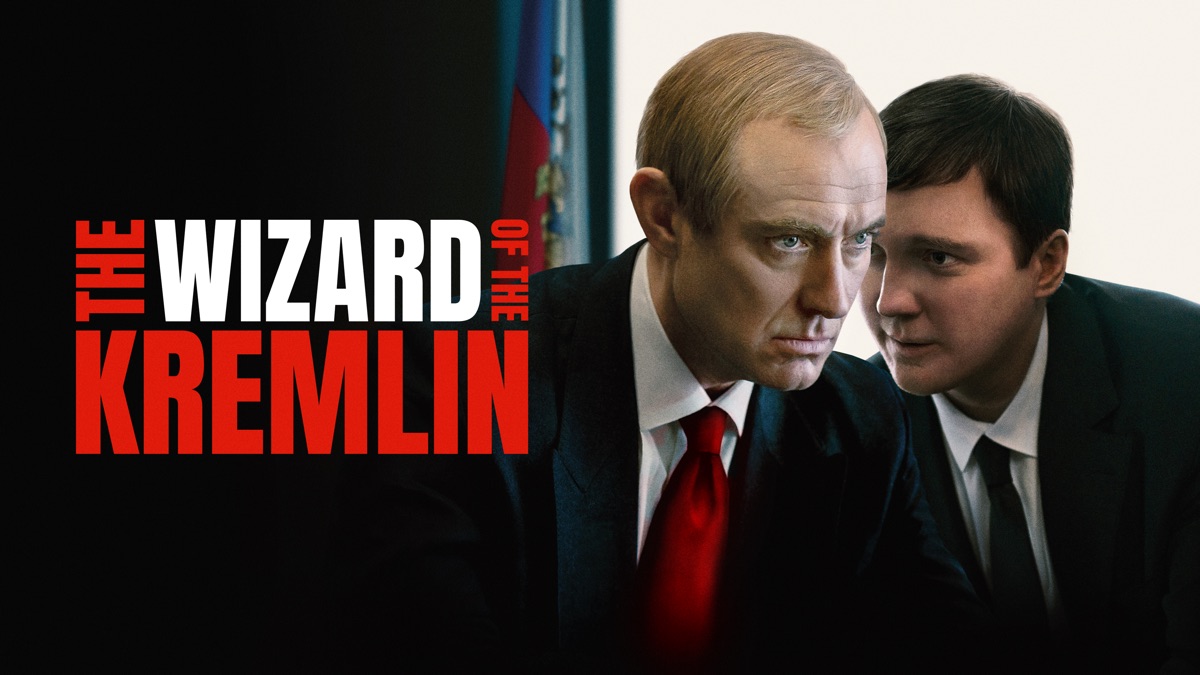
Somewhere in the more than 2-hour long movie The Wizard of the Kremlin there’s an interesting movie. You catch glimpses of it whenever Jude Law’s Vladimir Putin walks onscreen brandishing a cold, calculating stare. My issue is I don’t have the bandwidth to enjoy those moments, because that requires sitting through a whole lot of dry exposition, and sluggish pacing.
The movie follows the journey of Vadim Baranov, played by Paul Dano, a fictionalized version of Kremlin strategist Vladislav Surkov, often described as one of the masterminds behind Putin’s rise. Basically, the movie is one long flashback covering decades of Russian history, starting in the chaotic post-Soviet early ’90s and eventually working its way toward Putin’s grip on power. And this is interesting and gripping … at first.
There’s this wild atmosphere to the early Russia scenes where everyone suddenly has money, freedom and no idea what to do with either. Artists, oligarchs and opportunists all crash into each other at loud parties and sketchy business meetings. It all represents the shiny new capitalist dream Russia was chasing at the time. Those scenes feel alive, but once Baranov gets deeper into politics, the film slowly turns into a history lecture.
Huge events like the Chechen War, apartment bombings, the Kursk submarine disaster and Putin’s political ascent get rushed through so quickly that they barely land emotionally. Assayas seems more interested in making sure every historical checkpoint gets mentioned than building tension or drama.
Paul Dano doesn’t help much. He’s so restrained and low-energy here that Baranov often comes across less like a master manipulator and more like a guy quietly waiting for his coffee. The film makes like he’s a genius puppeteer shaping reality, but we rarely see him doing anything clever onscreen. Most of his wizardry boils down to long talks explaining his manipulation after the fact.
As usual, Jude Law is genuinely good. His Putin isn’t loud or theatrical. He plays him like a man who already knows he’s the smartest and most dangerous person in every room. There’s something unsettling about how calm he is the entire time. Whenever Law and Dano share scenes together, the movie suddenly wakes up, and you get a glimpse of the darker, more sinister political thriller hiding inside this movie.
It’s all quite frustrating, as the ideas behind this film are genuinely interesting. The film wants us to see how authoritarianism doesn’t need to arrive with giant dramatic speeches and marching armies. In this case it creeps in slowly. There are moments where Assayas really taps into how scary that can be, especially when the movie draws parallels between propaganda, reality television and modern politics.
But you get worn out as the pacing drags, the dialogue gets repetitive and the framing device with Jeffrey Wright never really justifies its existence. By the final act, when Baranov starts reflecting on whether helping build Putin’s regime cost him his soul, the film doesn’t have much momentum left.
If you’re a political junky or fascinated by modern Russian history, this could be great for you. The production design is solid, Jude Law delivers a strong performance and the movie occasionally lands on some genuinely unsettling observations about how easily truth can be shaped by the people controlling the narrative. But for me it’s a 4/10.
