

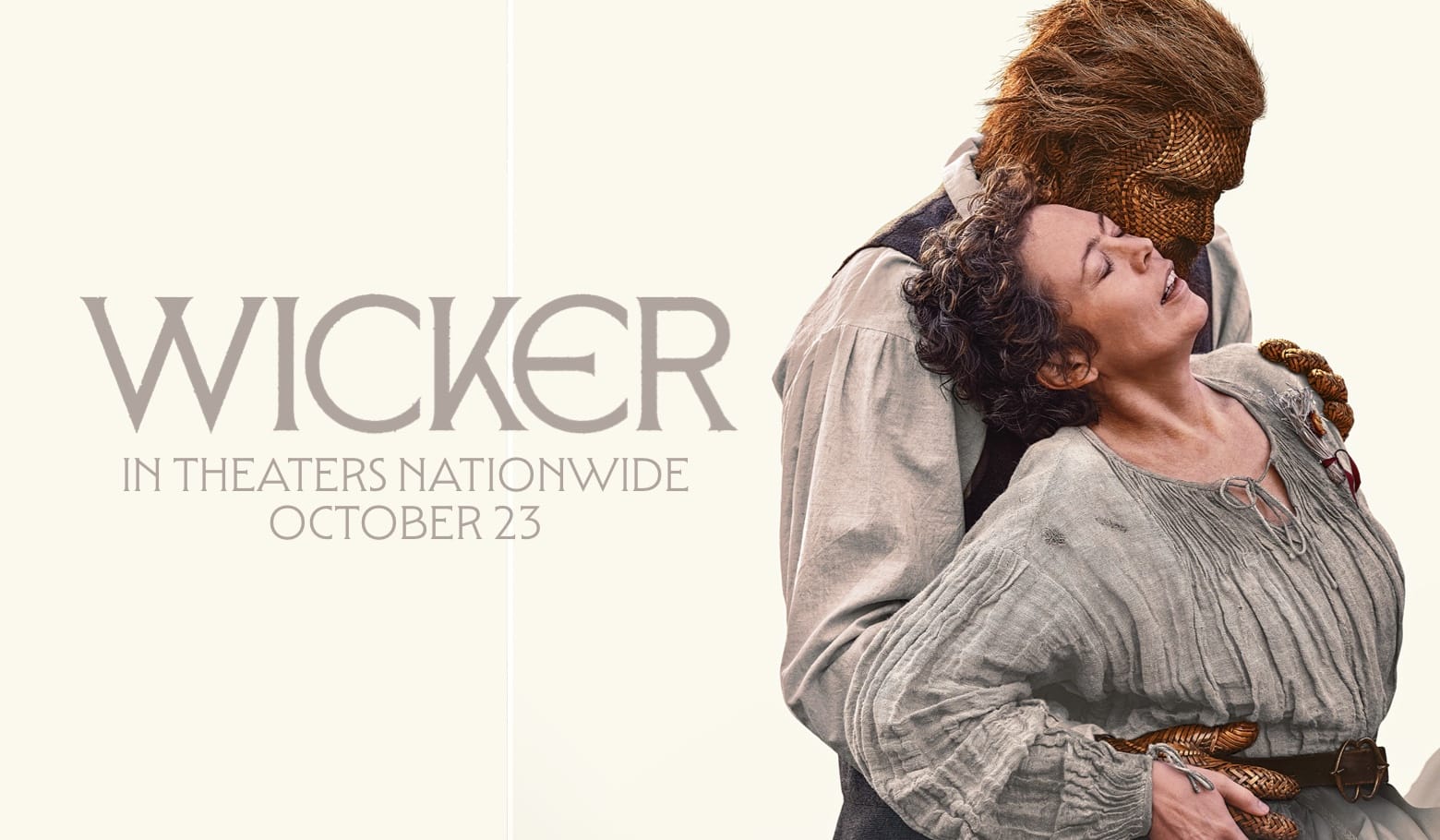
In case you’re not terminally online like I am, a “hear me out” is a fictional character (or occasionally a real life celebrity) that is far from conventionally attractive, but nevertheless, you have considered for…romantic entanglements. Enough to argue your case to others by starting with “Hear me out..” Let me tell you, I have seen it all with these. Anyone from Bowser from the Super Mario franchise and Kovu from The Lion King 2, to Microsoft’s assistant animated assistant Clippy. People are weird and thirsty, I guess. And I think film studios are finally getting wise to that.
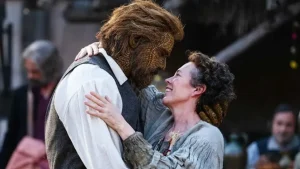
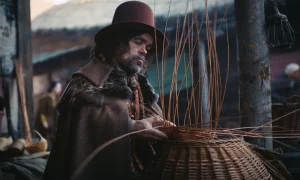
My evidence? The existence, ad campaigns, and sheer hype I’m seeing with Wicker, a unique live action fable based on the short story “The Wicker Husband” by Ursula Wills-Jones. Written and directed by husband and wife team Alex Huston Fischer and Eleanor Wilson, Wicker is about a lonely fisherwoman (Olivia Colman) who lives in a medieval peasant village governed by strict societal roles, tradition, and superstition. While never trusting anyone enough to take a husband of her own, the fisherwoman’s loneliness drives her to finally commission the enigmatic local basketmaker (Peter Dinklage) to make her a magical living wicker husband (Alexander Skarsgård). Let’s just say, it was an immediately happy marriage, as the wicker husband satisfies the fisherwoman’s loneliness in every way possible. Not everyone is happy however as the women of the village begin to become jealous of the kind attentive wicker husband. And that jealousy leads to their husbands’ resentment towards him.
As I mentioned earlier, the advertisements for this film certainly know who their target audience is, as anyone with a less than conventional “hear me out” (as well as most of the Booktok community) are going to absolutely eat this up. And yes, the romantic scenes are every bit as steamy as the ads make them out to be. But I’m going to spoil this a little for you. The steamy bits are not what’s important in this film, nor are they what makes it good. Because I can confidently say, this film was very good. Far better than even I was expecting.
On a technical level alone, Wicker is beautiful to behold. Here we see hauntingly beautiful establishing shots that show the perfect subtle passage of time, and color grading that holds a dreamlike quality reminiscent of Hamnet. The most impressive technical achievements, however, are the wicker husband himself. Weta Workshop gave us yet another masterclass in makeup, costuming, and just the right amount of CGI magic. The woody sheen, the way the light gently filtered through the tiny holes in his weave, even the little noises that were made each time he moved convinced me that I was genuinely seeing a real magical man woven from wicker.
The overall charm for Wicker, however, comes from the fact that it is through and through, unapologetically a fairytale. And while many would classify this as a “dark fairytale,” I will insist that it’s what I call a “grey fairytale.” It’s neither optimistic, nor pessimistic. It doesn’t shy away from dark, even disturbing topics, but then becomes lighthearted a moment later. And once more, not one that even takes place in a known time and place in our world’s history.
Did I say it was medieval? I meant that purely in the clothing and technology level, not the actual time period here on Earth. Because throughout the film, it becomes more and more apparent that the entire setting itself may or may not be on Earth to begin with – at least not any version of it we know about. Notice how I haven’t mentioned any proper names for the characters? That’s because there are none, everyone in this culture goes by a title based entirely on their occupation or relationship with someone in said occupation.The realization that this world only shares the visual vocabulary of medieval Europe without any of the actual historical constraints suddenly opens it up to showing some delightful little details about this society. This is another great example of a work whose community is a major character in and of itself. And that becomes extremely important in the end when the overall lesson of the fable finally comes to collect.
Of course, I don’t want to spoil any more of that for you. But to wrap up with one final thought: Why are so many people gleefully admitting, even celebrating their “hear me outs?” Perhaps it’s the sheer novelty, or the shock value of it all – and even in that case, I think Wicker will be an enjoyable film for many in that category. But, dare I say, can it also be because we imagine these unorthodox imaginary romances might fulfill some deep emotional need that we somehow aren’t getting from reality? Are we projecting ideals such as devotion and understanding on these otherwise unusual characters, turning them into figurative “strawmen”? If that is also the case for you, Wicker may hold even more value. In the end, the wicker husband isn’t appealing nor threatening because of his novelty, but because he offers something that should be anything but novel: standards. As for me, this film is an instant classic – an enchanting mature fairytale that explores the roles we play, trust, fulfillment, and most importantly, the meaning of love.