

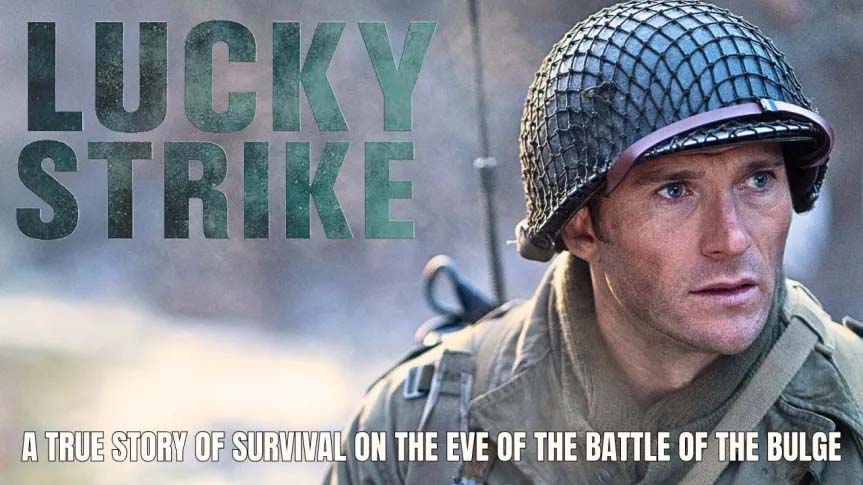
World War II remains one of Hollywood’s most explored settings, yet filmmakers continually return to the conflict hoping to uncover a new perspective. Director Rod Lurie’s Lucky Strike is just another film trying to woo crowds in that sweet patriotic season between June 6th and July 4th. While the film is clearly made with respect for the soldiers who fought in the Battle of the Bulge, it ultimately delivers a generic survival story that struggles to justify its existence within an already crowded genre.
While watching Lucky Strike, two thoughts crossed my mind. First, the movie feels like dozens of war films that have come before it, relying heavily on its period setting as though historical authenticity provides dramatic weight. Second, Scott Eastwood doesn’t seem to have his heart in this. The son of Hollywood icon Clint Eastwood possesses a natural screen presence, but I don’t see him carrying a scene with the same stoic intensity and quiet confidence that made his father a star. And the last 10 years haven’t been all that kind to him either. We see underwhelming efforts like Stolen Girl, Alarum, Tin Soldier, and now Lucky Strike. Eastwood once again finds himself trapped in material that fails to raise the bar. Maybe he’s not getting good scripts?
As for this movie, Captain John Castle, played by Eastwood, is a soldier during the Battle of the Bulge. After leading a mission to destroy a critical roadway and halt the advance of Germany’s feared First SS Panzer Division, Castle becomes stranded behind enemy lines when his unit is wiped out. Armed with only a radio, a wounded leg, and determination to survive, Castle embarks on a dangerous journey through occupied Belgium as he attempts to return to Allied territory.
On paper, the premise has potential. However, Lucky Strike never generates the suspense, urgency, or emotional investment necessary to make Castle’s journey compelling. Much of the blame lies with the screenplay by Lurie and longtime collaborator Mark Frydman, which frames the wartime events as an extended flashback. This is a played out war film trope by this point.
Also, the character, Castle, is frustratingly underdeveloped. We learn little about him beyond the familiar war-movie shorthand of having a wife and child waiting at home. The supporting soldiers are equally thinly drawn, making their deaths feel more like obligatory plot points than genuine tragedies. Even Castle’s reactions to the loss of his men seem strangely detached, undermining the emotional resonance the film repeatedly strives to achieve.
Lurie has demonstrated a stronger command of military storytelling before, particularly with 2020’s The Outpost. Here, however, the direction feels surprisingly restrained. While several battle sequences are competently staged and occasionally effective, the film often resembles an educational museum exhibit rather than a gripping war drama. Long stretches of Castle walking through forests, hiding from patrols, and exchanging sporadic gunfire lack the intensity necessary to sustain interest.
One of the film’s greatest challenges is the simple reality that the World War II genre has become overwhelmingly crowded with masterpieces. Any new entry inevitably invites comparisons to films such as Saving Private Ryan, Letters from Iwo Jima, Enemy at the Gates, and The Thin Red Line. These films distinguished themselves through groundbreaking filmmaking, moral complexity, unforgettable characters, or profound thematic depth. Lucky Strike offers none of those qualities. Instead, it occupies an awkward middle ground: too conventional to feel fresh, yet too modest in scope to compete with the genre’s most celebrated achievements. The result is a film that feels less like a meaningful addition to WWII cinema and more like a lesser echo of movies audiences have already seen.
The film’s framing device, involving Castle’s postwar visit to a grieving mother played by Aunjanue Ellis-Taylor, proves equally ineffective. What initially appears to be a meaningful emotional thread ultimately culminates in a sentimental reveal that feels forced rather than earned.
Ultimately, Lucky Strike is not an outright disaster, but it is a disappointingly lifeless one. It is a well-intentioned war film that never discovers what makes its story unique or necessary. Eastwood gives a committed performance, but neither he nor the supporting cast can overcome a screenplay lacking tension, character development, and emotional depth. In a genre filled with unforgettable classics, Lucky Strike struggles to leave any lasting impression at all. The best I can do is a 4/10.
