

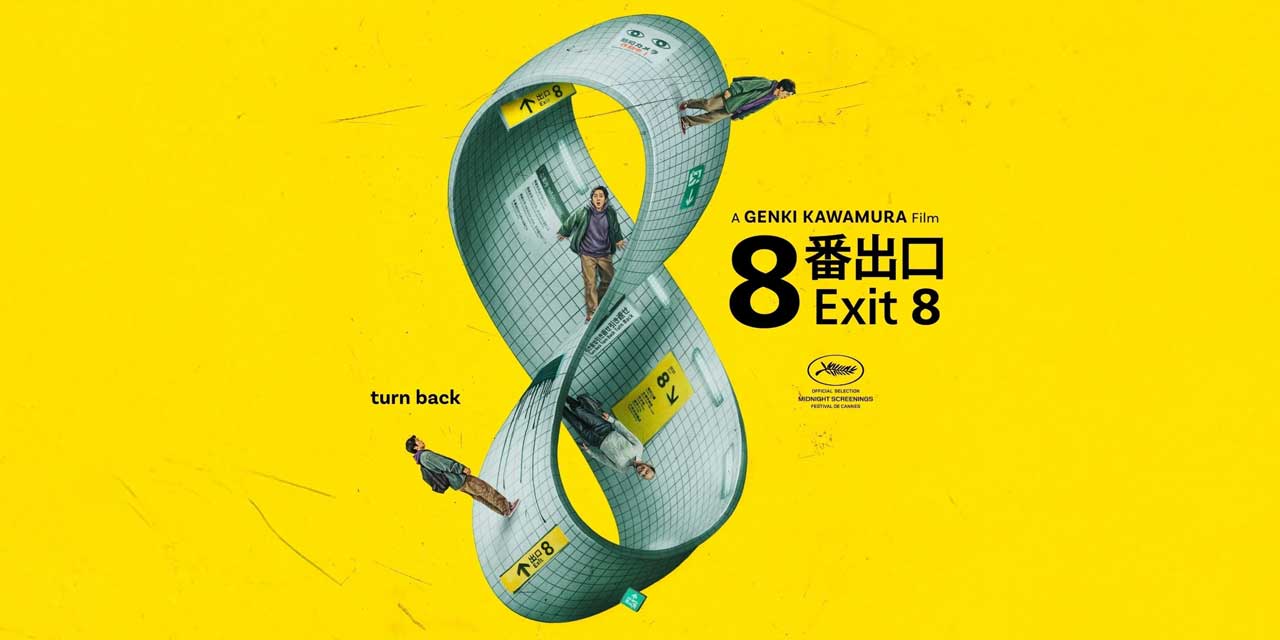
Think about the spaces we pass through without thinking. Fluorescent hallways, sprawling supermarket aisles and places designed not to be lived in but simply endured for long enough to pass through. In 2026, movie makers seem obsessed with these beige voids, from The Backrooms to newly released Exit 8, films that turn transitional architecture into psychological traps. But where The Backrooms promises scale, Exit 8 thrives on something far more intimate: repetition, observation, and creeping dread.
The film is adapted from the 2023 indie video game Exit 8 from Kotake Create. The game was released on Steam and quickly became a sensation for its deceptively simple premise and spread to most other popular platforms. Director Genki Kawamura resists the urge to overcomplicate. The film understands that the power of indie horror lies in constraint. Its world is small, its rules are rigid, and its terror comes not from spectacle but from the slow erosion of certainty.
Kazunari Ninomiya plays the so-called Lost Man. His descent into the labyrinth begins mundanely as a subway commute, headphones in, the world politely ignored. But a phone call from his ex-girlfriend fractures his routine. She’s pregnant, and the decision of what comes next is, uncomfortably, left entirely to him. It’s a narrative choice that lingers over the film introducing a thematic bluntness that clashes with the otherwise elegant ambiguity.
From there, the film locks itself into its central conceit: an endless loop of nearly identical subway corridors beneath Tokyo. Signs instruct the Lost Man to search for anomalies. He needs to watch for small, uncanny deviations, or sometimes not so small deviations in the environment. A misplaced poster. A flicker in the lighting. A man whose face shifts from neutral to grotesque when you aren’t quite looking. If something is wrong, turn back. If not, proceed toward Exit 8. Fail, and the loop resets.
The premise could collapse under the weight of so much repetition, but Kawamura and cinematographer Keisuke Imamura lean into the monotony. Extended takes force the viewer into the same hyper-vigilant state as the protagonist, scanning every inch of the frame for inconsistencies. Where the game demands you lean forward, eyes inches from the screen, the film does something more interesting: it asks you to lean back, to take in the whole image and still feel like you’re missing something.
The supporting characters, expanded from near-nonexistence in the source material, are where the film finds unexpected texture. Yamato Kochi’s character the Walking Man begins as a simple looped figure. He’s an almost animatronic presence drifting through the corridors, but gradually the film reveals a quiet desperation that reframes the character’s entire ordeal. The Walking Man now has an arc that is tragic in its inevitability and injects real stakes into what might otherwise feel like an abstract puzzle. Similarly, Naru Asanuma’s character the Boy offers a counterpoint to the Lost Man’s paralysis: observant, adaptive, and unsettlingly at ease within the rules of this broken world.
The one area Exit 8 falters, is also what makes it successful. It’s in its reluctance to stray too far from the source material’s structure. There are real missed opportunities to escalate its horror. You can sense the movie hit the source material’s ceiling in minutes. What lingers isn’t any single moment of terror, but the cumulative effect of being watched by a space that doesn’t care if you understand it. The subway becomes less a setting and more a system that tests, judges, and resets without explanation. It’s the kind of overlording presence that feels tailor-made for the internet age.
This film adaptation was released in the shadow of video game movie The Super Mario Galaxy Movie. It is absolutely overshadowed by the Nintendo juggernaut, but are we surprised? However, if you’re a parent, send the kiddos into the Mario movie and sit yourself down for Exit 8. Where Mario offers bright familiarity, Exit 8 offers something far rarer: a complete, self-contained descent into psychological unease that requires no prior knowledge to appreciate. It does not redefine horror, but Exit 8 succeeds where it counts. It gets under your skin, rewires the way you look at empty spaces, and makes you want to go back and try again. Solid 7/10 movie.