

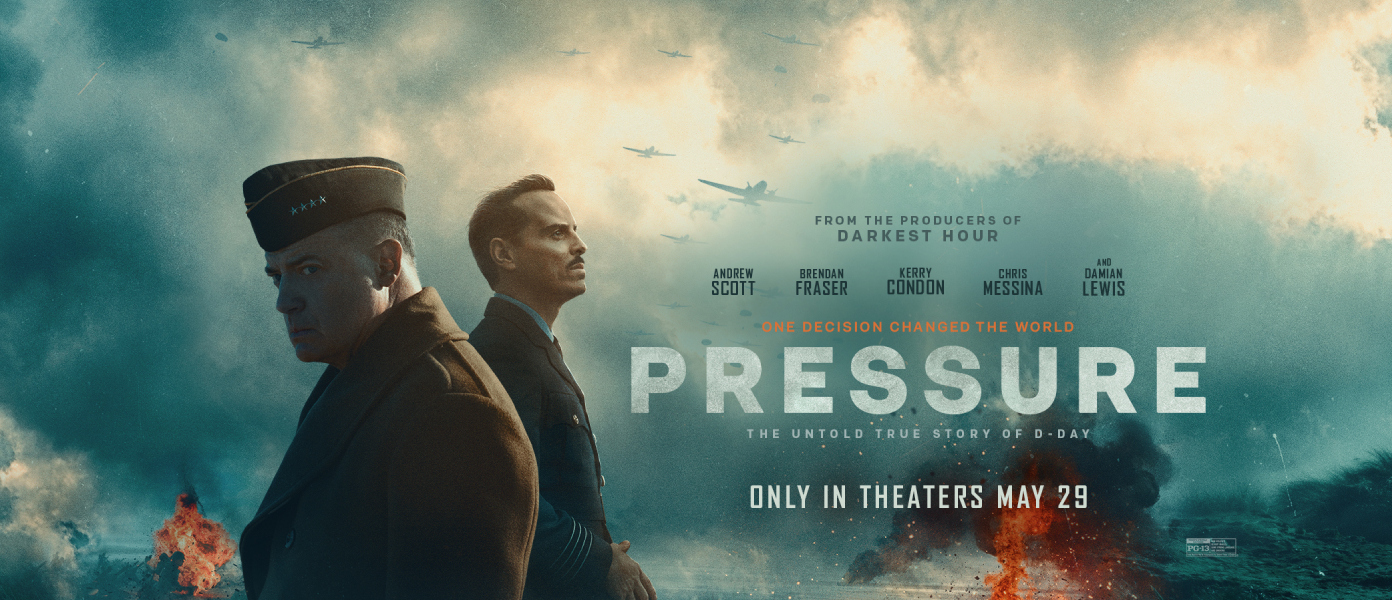
Despite knowing how deeply important they are for society, I’m generally lukewarm on war films. I don’t say that loudly or proudly, but it’s true. There are exceptions, of course, and they tend to share one quality, that they’re less interested in the battlefield than in the rooms adjacent to it such as The Imitation Game, Darkest Hour, and especially Doctor Strangelove. Films about the experts, the analysts, the people whose minds quietly changed the course of history while the generals got the statues. The latest WWII historical drama Pressure belongs firmly in that company, and in some ways surpasses it.
Directed by Anthony Maras and adapted from David Haig’s 2014 stage play, Pressure unfolds across the 72 hours before D-Day, the Allied invasion of Normandy that would ultimately break Nazi Germany’s grip on Western Europe. The central tension is deceptively simple: should General Dwight D. Eisenhower (Brenden Fraser) proceed with the largest seaborne invasion in history, or trust the one meteorologist telling him the weather won’t cooperate? That meteorologist is Captain James Stagg (Andrew Scott). And almost nobody wants to listen to him.
The title earns itself twice over. Atmospheric pressure, the literal subject of Stagg’s expertise, the variable that could doom or deliver thousands of men, and the crushing institutional weight felt by every character onscreen. Eisenhower carries the failed test mission already on his conscience and the fate of the free world on his shoulders, while Stagg carries data that nobody wants to hear. Both men are being asked, in different ways, to bend reality to what the room needs it to be. The crux of this film is how neither of them does.
Brendan Fraser as Eisenhower continues the quieter, weightier second act of his career with real conviction. I can’t personally verify the accuracy of the speech patterns or mannerisms of Eisenhower (sorry, never met the dude), but I can tell you that whoever Fraser was playing, it wasn’t Brendan Fraser. He renders Eisenhower as a man simultaneously approachable and terrifying — casually warm in one breath, volcanic in the next, always visibly burdened by the scale of what he’s been handed. I find myself curious now as to what the real Eisenhower was like. Even if the film didn’t get him accurately, Fraser created a wonderfully nuanced version of him that worked well in this instance.
Andrew Scott carries the film’s moral and emotional center as Stagg, and does so with extraordinary economy. This is not a man who wastes words. He is present for one purpose: to collect data, analyze it, and report it accurately—and he pursues that purpose with the kind of quiet intensity that reads, at first, as coldness. They make it apparent from the beginning it isn’t. There is a storm perpetually gathering behind his eyes, and the film’s most devastating scene releases it without a single speech.
Midway through the film, Stagg receives a phone call while being dressed down by Eisenhower: his pregnant wife is missing after a hospital bombing. He takes a few seconds, just seconds to absorb it in silence, and returns to making his case. The power dynamic in that room inverts completely in that moment. Eisenhower has all the rank. Stagg suddenly has all the moral weight. It’s the scene the entire film is quietly building toward, and Scott makes it almost unbearable to watch.
Kerry Condon as Kay Summersby, Eisenhower’s personal secretary, brings a precision and grounded intelligence to what could easily be an underwritten role. She is the room’s emotional barometer, the one person tracking not just the logistics but the human cost of every exchange. Condon makes her indispensability completely believable without ever overplaying it. Damian Lewis as Field Marshal Montgomery is more sparingly used but no less effective, his pomposity a crucial instrument in the pressure being applied to Eisenhower from every direction.

For a film adapted from a stage play, Pressure is remarkably cinematic, even quiet at times. Maras understands what the camera can hold that the stage cannot: the exchanged glance, the solo reaction shot, the face processing something it cannot yet speak aloud. There are moments of perhaps slightly indulgent scene-setting, but in a film this deliberately paced, that breathing room earns its keep. This is not a war film interested in the spectacle of combat. The D-Day landing footage, when it comes, is surprisingly visceral for a PG-13 rating, restrained enough for squeamish people like myself, yet honest enough to get the idea of the violence across with respect. The integration of real archival footage is one of the film’s most quietly powerful choices. It doesn’t feel grafted on or documentary-adjacent. It feels like the film vouching for itself. Closing the distance between historical drama and lived history in a way that a title card never could.
Pressure is a film about what it costs to tell the truth when the truth is inconvenient. About data as a form of moral courage. About the calm eye of the storm in a room that is a veritable hurricane of conflicting opinions. It’s the kind of war film that we don’t know that we need, until history threatens to repeat, and we are faced with the choice between listening to experts or complete failure.