

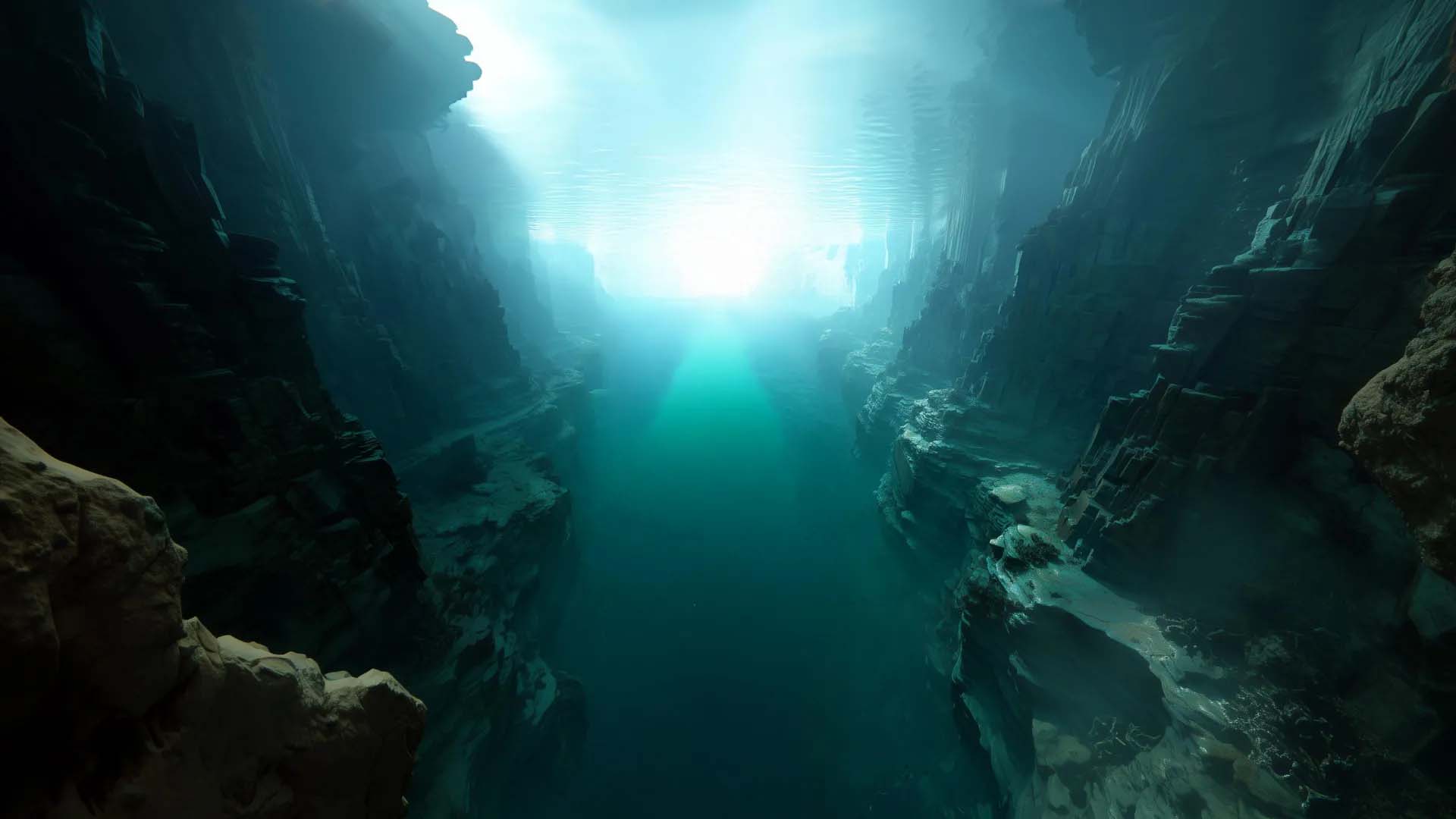
A hidden mantle plume helped the Atlantic seafloor rip open, creating an underwater canyon system bigger than the Grand Canyon.
On land, dramatic canyons such as the Grand Canyon are carved over time by flowing rivers. The ocean does not have rivers capable of cutting into rock on that scale. Even so, the seafloor hosts enormous features that surpass the size of the largest land canyons.
About 1,000 kilometers off the coast of Portugal lies one of the most striking examples. Known as the King’s Trough Complex, this vast underwater structure stretches roughly 500 kilometers and includes a series of parallel trenches and deep basins. At its eastern edge is Peake Deep, one of the deepest locations in the Atlantic Ocean.
“Researchers have long suspected that tectonic processes — that is, movements of the Earth’s crust — played a central role in the formation of the King’s Trough,” says lead author Dr. Antje Dürkefälden, marine geologist at GEOMAR. “Our results now explain for the first time why this remarkable structure developed precisely at this location.”
Seafloor Rifting Between Europe and Africa
The new research indicates that between about 37 and 24 million years ago, a plate boundary separating Europe and Africa temporarily passed through this part of the North Atlantic. As the tectonic plates shifted, the crust in this region was pulled apart and fractured, opening progressively from east to west, much like a zipper being undone.
An important piece of the puzzle lies even deeper. Before the plate boundary moved into the area, the oceanic crust there had already become unusually thick and heated. This condition resulted from hot material rising upward from Earth’s mantle. Known as a mantle plume, this steady column of molten rock originates far below the surface. The team believes this was an early offshoot of what is now the Azores mantle plume.
“This thickened, heated crust may have made the region mechanically weaker, so that the plate boundary preferentially shifted here,” explains co-author PD Dr. Jörg Geldmacher, marine geologist at GEOMAR. “When the plate boundary later moved further south towards the modern Azores, the formation of the King’s Trough also came to a halt.”
How Mantle Activity Shapes the Atlantic
The King’s Trough offers a clear example of how deep mantle processes and shifting tectonic plates interact. Activity far below the surface can prepare the crust for later deformation, influencing where major fractures and rifts eventually develop.
Mapping the King’s Trough
The conclusions are based on data collected during research expedition M168 aboard the research vessel METEOR in 2020, led by Antje Dürkefälden. The scientists used high resolution sonar to produce a detailed map of the seafloor. They then retrieved volcanic rock samples from several parts of the trench system using a chain bag dredge.
Back in the lab, the team examined the chemical makeup of the rocks. Selected samples were dated at the University of Madison (Wisconsin, USA). Additional bathymetric data came from the Portuguese research centre Estrutura de Missão para a Extensão da Plataforma Continental (EMEPC). Researchers from Kiel University and Martin Luther University Halle-Wittenberg also contributed to the study.
Journal Reference:
- A. Dürkefälden, J. Geldmacher, F. Hauff, M. Stipp, D. Garbe‐Schönberg, D. A. Frick, B. Jicha, L. Pinto Ribeiro, M. Gutjahr, J. Schenk, K. Hoernle. Origin of the King\’s Trough Complex (North Atlantic): Interplay Between a Transient Plate Boundary and the Early Azores Mantle Plume. Geochemistry, Geophysics, Geosystems, 2025; 26 (12) DOI: 10.1029/2025GC012616
From: ScienceDaily.com