

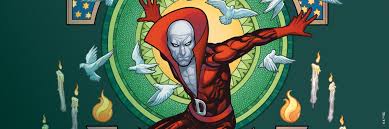
You can’t keep a good Deadman down. DC’s resident circus performer turned supernatural avenger Boston Brand has captured the imaginations of comics fans for over fifty years with his tragic origin and unique ability to take control of anyone’s body.
The character was conceived by Arnold Drake, the co-creator of the equally offbeat Doom Patrol. As Drake explained in his foreword to the first volume of the collected Deadman Book One, he drew inspiration from 1960s America’s fascination with the search for enlightenment via Eastern spirituality.
“I wanted a supernatural theme,” said Drake. “A hero who was a dead man? Okay. But he must look like Death. And who’d look that way in life? Someone courting death for a living—with clothes to match: a circus aerialist in a skull-and-bones-costume, billed as ‘Deadman!’ Some Eastern deity empowers his spirit to search the Earth for his murderer… With that discovery, everything fell into line.”
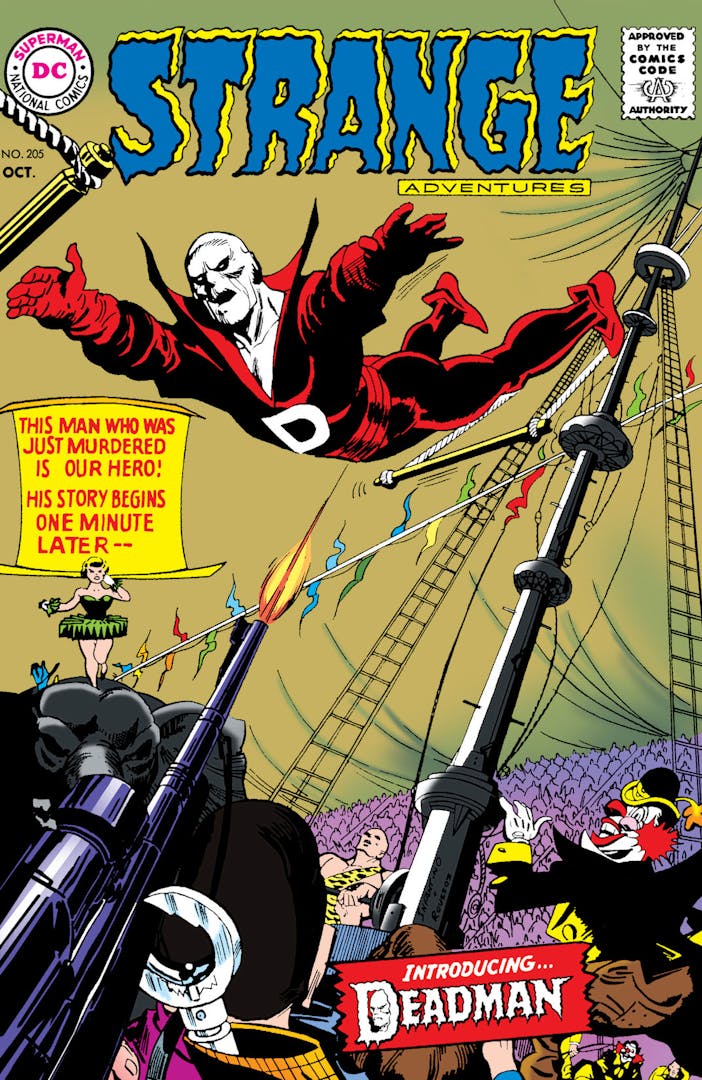
DC’s then Art Director Carmine Infantino—co-creator of the Barry Allen Flash, the Barbara Gordon Batgirl, and scores of other characters—was enlisted by editor Jack Miller to pencil Deadman’s first appearance in October 1967’s Strange Adventures #205, written by Drake and inked by George Roussos. Here, readers were introduced to Boston Brand and bore witness to his flying trapeze murder by an unknown assassin. His spirit is immediately set free by the deity Rama Kushna, who tells Brand he has the power to walk among men until he’s found the one who’s killed him. The core component of this power is the ability to possess other people’s bodies.
With Infantino’s schedule giving him little time for pencilling, Deadman’s distinct look and ability were shown to even greater effect when artist Neal Adams began his much-praised run on the character, starting with his second appearance in Strange Adventures #206. New to DC, Adams, with his trademark dynamic realism and innovative layouts, took full advantage of the character’s potential. It wasn’t long before Adams was scripting his own Deadman stories, as well as inking himself. This paved the way for Adams’ iconic ‘70s work on Batman, Green Lantern and Green Arrow.
In his preface for the Deadman Book Two collection, Adams remarked, “For the first time in my comics career, I felt that we could do a series concentrating on a character’s actual character with Deadman. That’s how it started out—the story should be his story, his torment, his failure, his success.”
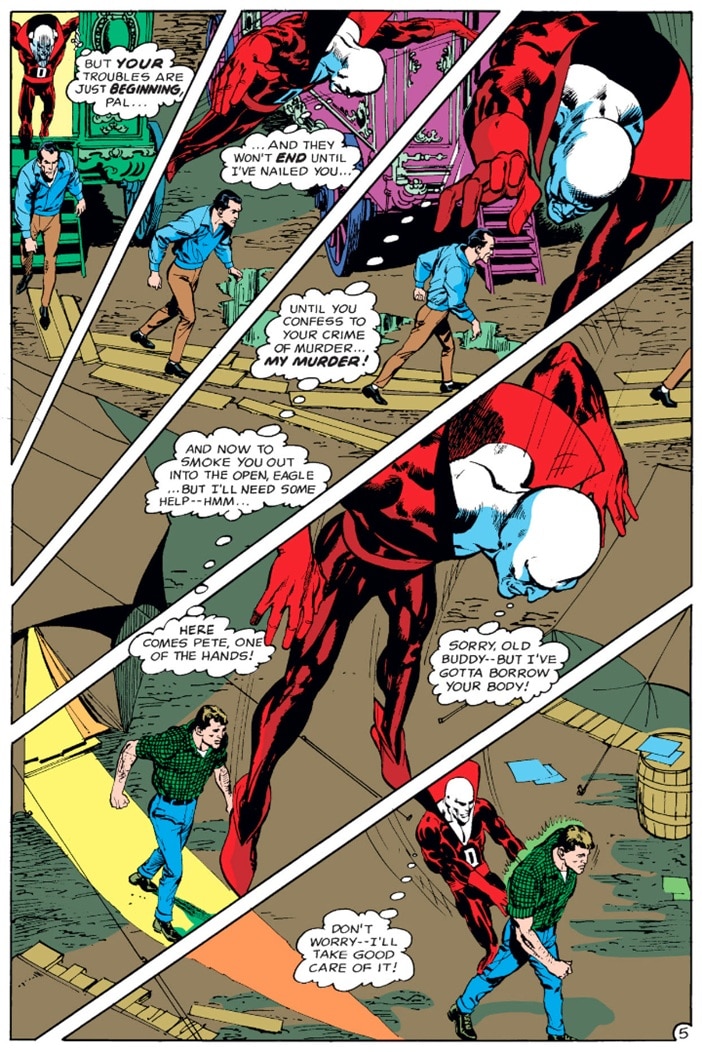
Deadman’s original storyline—the remainder of which was illustrated by Adams—lasted through Strange Adventures #216, including a few chapters in The Brave and the Bold, Aquaman and Challengers of the Unknown. By this time, Boston Brand had found his killer, but was unable to resume his corporeal form and was cursed to remain Deadman forever.
The character made guest appearances throughout the 1970s and ‘80s in various other comics (gathered in Deadman Book Three), the highlight of which was a run starting in Adventure Comics #462 (featured in Deadman Book Four) pairing writer Len Wein and penciler Jose Luis Garcia-Lopez—perhaps the only man alive whose draftsmanship of the character equaled Adams’. Garcia-Lopez returned for a four-issue Deadman limited series in 1986, written by Andrew Helfer (featured in Deadman Book Five). When Action Comics became a weekly anthology title with May 1988’s issue #601, Deadman earned a run in its pages. Initially written by Mike Baron with pencils by Dan Jurgens, Kelly Jones became the strip’s artist with Action Comics #618.
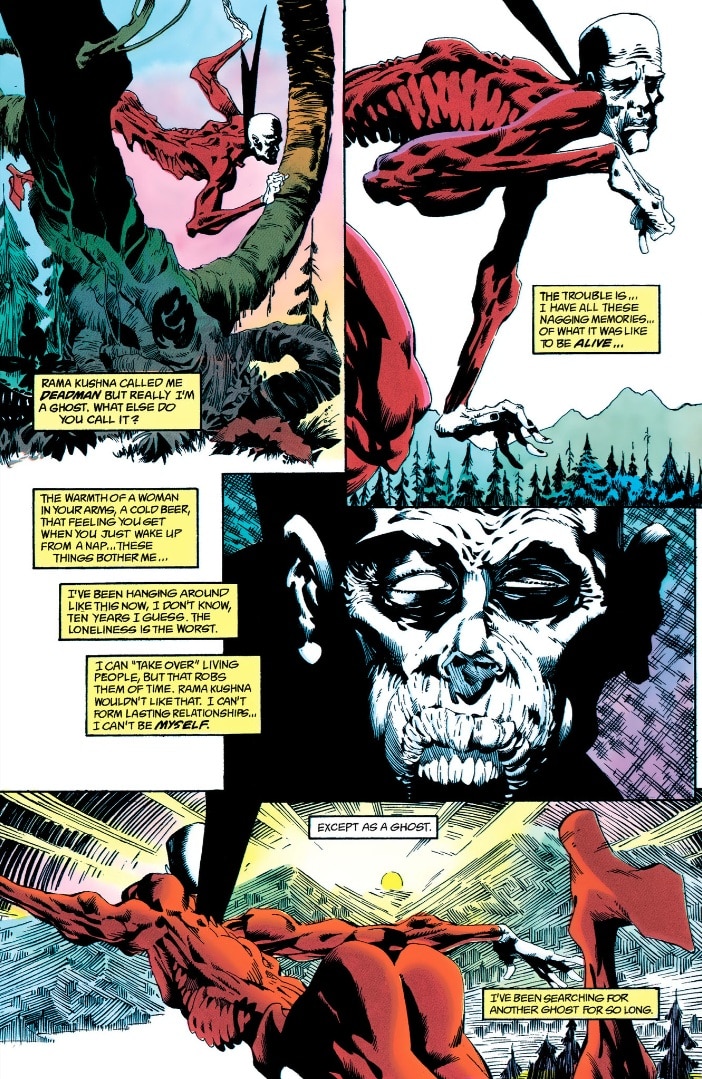
Jones, who worked in the horror tradition of EC Comics’ Graham Ingels and Swamp Thing co-creator Bernie Wrightson, was the third great Deadman artist, after Adams and Garcia-Lopez. His take on the character, however, was vastly different than that of his predecessors. This was especially true when Jones and Baron followed their Action Comics run with the two-issue Deadman: Love After Death in 1989 and Deadman: Exorcism in 1992. For the first time, Boston Brand truly looked like a dead man: a gangly cadaver clad in a circus costume. Jones’ art highlighted the character’s tragedy, along with his alienation from humanity.
Other guest appearances and solo titles followed, including a stint as a White Lantern in 2010’s Brightest Day and membership in 2011’s Justice League Dark. A Deadman strip in 2009’s tabloid-sized Wednesday Comics showcased gorgeous cartooning from Batman: The Animated Series/The New Batman Adventures storyboard artist Dave Bullock. Deadman has also appeared in various DC animated projects, including an adorable, kid-friendly version in 2011’s DC Nation Shorts.
This week, Deadman will again walk on the dark side of the DC Universe in the six-issue limited series The Deadman. Written and illustrated by W. Maxwell Prince and Martín Morazzo—the folks responsible for Ice Cream Man and Superman: The Kryptonite Spectrum—this wholly imaginative Next Level title offers further proof that, like death itself, Deadman has no limits.