

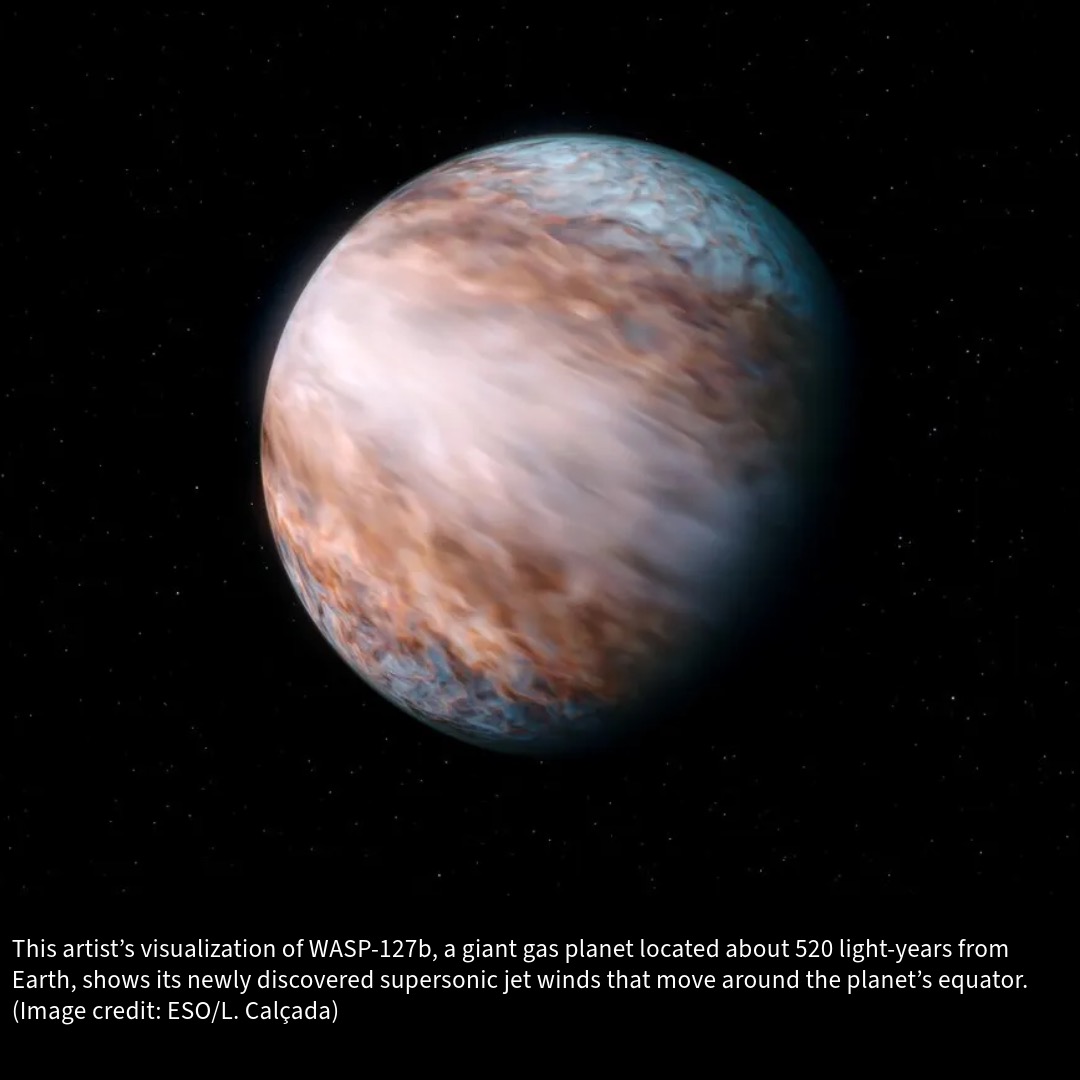
5.6 miles per second (9 kilometers per second), or 20,500 miles per hour (33,000 kilometers per hour) — the fastest winds ever measured on a planet.
The faraway world, a gas giant called WASP-127b that was discovered in 2016, orbits a star 520 light-years from Earth. It zips around its host star in just four days, following a slightly skewed orbit. The exoplanet is also likely tidally locked to its star the same way the moon is to Earth — but perhaps its biggest eccentric trait is that it is slightly larger than Jupiter, yet only 16% as massive, making it one of the puffiest planets known to astronomers. So, its heavily inflated nature enables eager astronomers to look through the upper layers of its atmosphere.
A team led by Lisa Nortmann of Germany’s University of Göttingen used a spectrograph on the Very Large Telescope in Chile to observe WASP-127b as it passed in front of its star, blocking some of its light. By analyzing the filtered light, which included distinct dips or “fingerprints” of various molecules that absorbed light at different wavelengths, the researchers identified the presence of carbon monoxide and water vapor in the planet’s upper atmosphere.
In studying that spectra further, the researchers say they were puzzled when they noticed two different wavelength peaks for these molecules, which indicated some of those molecules were moving away from Earth while others were moving toward Earth while others were moving away at the same speed.
“I was a little bit confused,” Nortmann told New Scientist. “But with a little bit more careful data analysis, it became clearer that there are two signals.
I was quite excited — my first thought was immediately that it has to be some sort of super-rotating wind.
”
Further analysis of the collected spectra showed the movement was maximum at the planet’s equator, so the team concluded the observations could be explained by supersonic winds that were constrained to the planet’s equator.
“This signal shows us that there is a very fast, supersonic, jet wind around the planet’s equator,” Nortmann said in a statement. “This is something we haven’t seen before.”
While the reasons for the staggering weather are not fully understood, the researchers interpret these winds to be six times faster than the speed at which the planet itself rotates. For comparison, Neptune holds the record for the fastest winds in our solar system; the winds on WASP-127b are an astonishing 18 times stronger.
The recent observations also suggest the planet has slightly different temperatures between its morning and evening sides, indicating it “has complex weather patterns just like Earth and other planets of our own system,” study co-author Fei Yan of the University of Science and Technology of China said in the same statement.
This research is described in a paper published last week in the journal Astronomy and Astrophysics.
From Space.com