

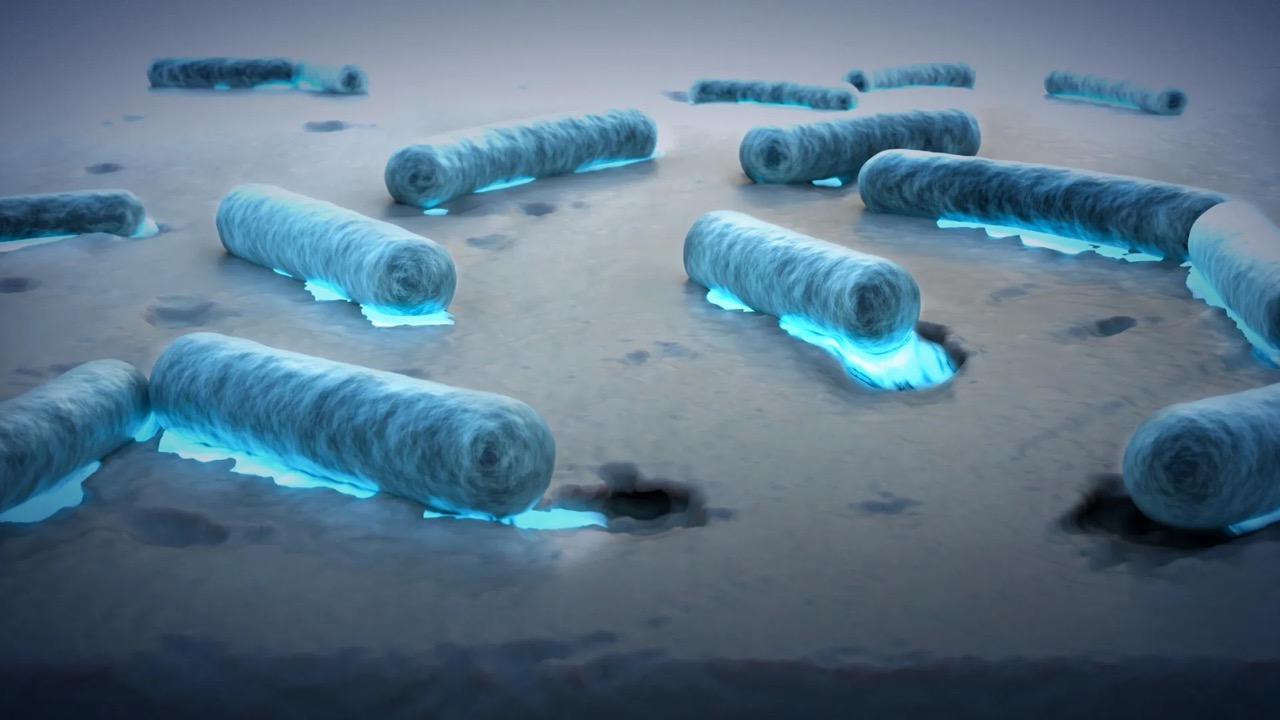
Far beneath the ocean’s surface, researchers have found bacteria that can digest plastic, using specialized enzymes that evolved alongside humanity’s synthetic debris.
A large-scale global study by scientists at KAUST (King Abdullah University of Science and Technology) revealed that these marine microbes are widespread and genetically prepared to consume polyethylene terephthalate (PET) — the tough plastic used in everyday items like drink bottles and fabrics.
Their remarkable ability stems from a distinct structural feature on a plastic-degrading enzyme called PETase. This feature, known as the M5 motif, acts as a molecular signature that signals when an enzyme can truly break down PET.
“The M5 motif acts like a fingerprint that tells us when a PETase is likely to be functional, able to break down PET plastic,” explains Carlos Duarte, a marine ecologist and co-leader of the study. “Its discovery helps us understand how these enzymes evolved from other hydrocarbon-degrading enzymes,” he says. “In the ocean, where carbon is scarce, microbes seem to have fine-tuned these enzymes to make use of this new, human-made carbon source: plastic.”
How Nature’s Recyclers Evolved
For decades, scientists believed PET was almost impossible to degrade naturally. That belief began to shift in 2016, when a bacterium discovered in a Japanese recycling plant was found to survive by consuming plastic waste. It had developed a PETase enzyme capable of dismantling plastic polymers into their building blocks.
Yet it remained unclear whether oceanic microbes had developed similar enzymes independently.
Using a combination of artificial intelligence modeling, genetic screening, and laboratory testing, Duarte and his team confirmed that the M5 motif distinguishes true PET-degrading enzymes from inactive look-alikes. In experiments, marine bacteria carrying the complete M5 motif efficiently broke down PET samples. Genetic activity maps showed that M5-PETase genes are highly active throughout the oceans, especially in areas heavily polluted with plastic.
Global Spread of Plastic-Eating Microbes
To understand how widespread these enzymes are, the researchers examined more than 400 ocean samples collected from across the globe. Functional PETases containing the M5 motif appeared in nearly 80 percent of the tested waters, ranging from surface gyres filled with floating debris to nutrient-poor depths nearly two kilometers below.
In the deep sea, this ability may give microbes an important edge. The ability to snack on synthetic carbon may confer a crucial survival advantage, noted Intikhab Alam, a senior bioinformatics researcher and co-leader of the study.
The discovery highlights a growing evolutionary response: microorganisms are adapting to human pollution on a planetary scale.
Although this adaptation reveals nature’s resilience, Duarte cautions against optimism. “By the time plastics reach the deep sea, the risks to marine life and human consumers have already been inflicted,” he warns. The microbial breakdown process is far too slow to offset the massive flow of plastic waste entering the oceans each year.
Turning Discovery Into Real-World Solutions
On land, however, the findings could accelerate progress toward sustainable recycling. “The range of PET-degrading enzymes spontaneously evolved in the deep sea provides models to be optimized in the lab for use in efficiently degrading plastics in treatment plants and, eventually, at home,” says Duarte.
The identification of the M5 motif offers a roadmap for engineering faster, more effective enzymes. It reveals the structural traits that work under real environmental conditions rather than just in test tubes. If scientists can replicate and enhance these natural mechanisms, humanity’s battle against plastic pollution may find powerful new allies in one of the planet’s most unexpected places: the deep ocean.
From ScienceDaily.com