

I will always maintain: I don’t need an excuse to love musicals. They are not some guilty pleasure, but rather a genre that uses song and dance as tools to convey a story. But if I did need a reason to love them, it’s because they help me escape reality better than most others. That leads me into a theme in films I also love: escapism itself used to advance the plot. Think The Fall, Sucker Punch, and arguably Pan’s Labyrinth. And when you combine the genre of musicals with the theme of escapism? Chef’s kiss.
With that in mind, I am delighted that we are finally being blessed with a film adaptation of the musical Kiss of the Spider Woman (originally running on Broadway in 1993 and winning the Tony for Best Musical). The musical itself was based on Manuel Puig’s 1979 novel of the same name—which also inspired a non-musical film adaptation in 1985. Have I confused you yet? This latest iteration was directed, adapted for the screen, and partially produced by musical film veteran Bill Condon.
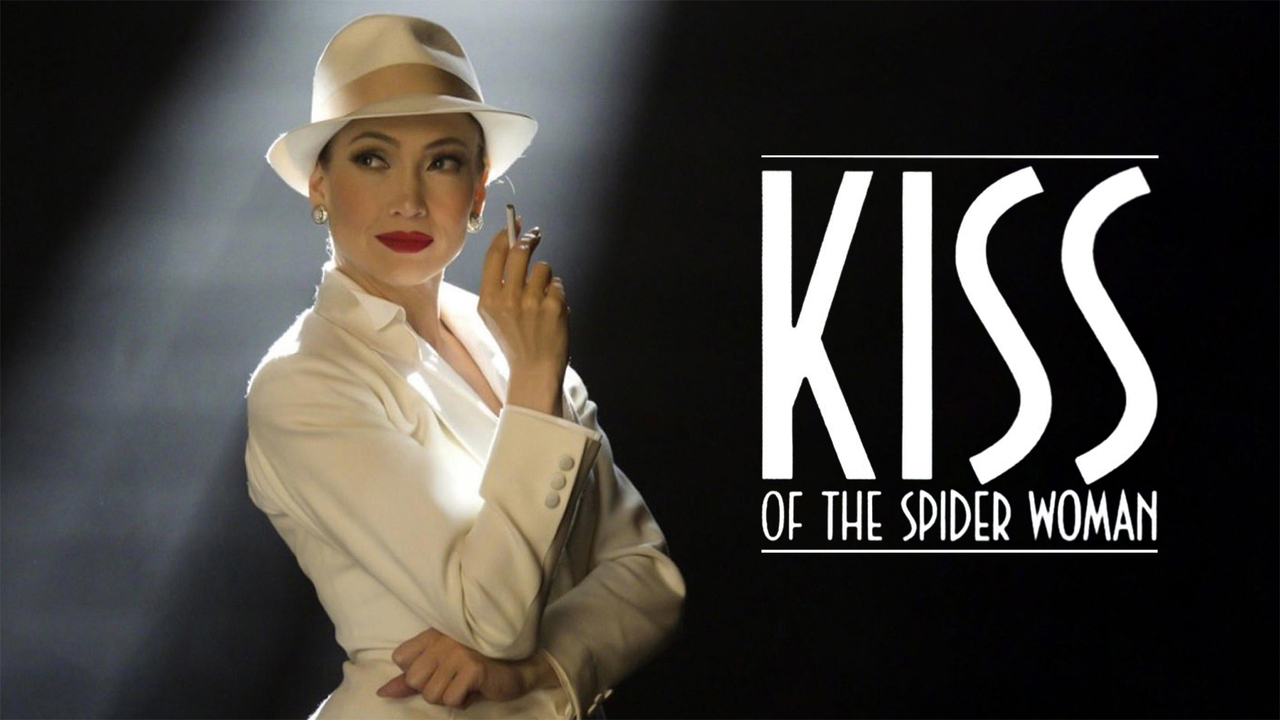
The story takes place in 1983 Argentina, primarily within a political prison. We follow Molina (Tonatiuh), a trans woman imprisoned for public indecency, who becomes the new cellmate of Valentin (Diego Luna), a leftist political prisoner. To pass the time (and to take their minds off their grim situation) Molina retells her favorite film, Kiss of the Spider Woman, starring Ingrid Luna (Jennifer Lopez), the type of woman she aspires to be. Despite their drastically different personalities and beliefs, the two slowly bond over Molina’s storytelling and their shared trauma of imprisonment.
I’ve always loved films (and plays) with a limited cast, or casts who take on multiple roles. It only works when the performers are exceptionally talented and have strong chemistry. Thankfully, that’s the case here. Tonatiuh is a revelation, stealing the show with a performance that evokes humanity without slipping into sentimentality. They balance delicacy and resilience with remarkable nuance. I’ve long admired Diego Luna’s work, and once again he impresses as Valentin, his restrained intensity perfectly fitting a revolutionary’s weary conviction. And of course, Jennifer Lopez shoulders the weight of the larger-than-life musical numbers. Her singing and dancing are as sharp as ever, and she embodies the face of Molina’s escapist fantasy with just the right blend of glamour and gravitas.
Yes, this is an unapologetically queer film (not much has changed from the 1979 novel), and it does not shy away from those elements. But even beyond queerness, it tells a profoundly human story. In 2025’s political climate, its themes of imprisonment, identity, and fantasy feel more poignant than ever. Some may criticize that the rapid mood shifts between colorful high energy musical numbers and the ugly reality of prison are jarring. I will argue that they are what make this film so effective. The colorful moments of musical fantasy are practically therapeutic for both the characters as well as the audience. They may make the pacing feel almost jarring at first, but this only serves to shed light on how trauma distorts the passage of time.
If I only had one (minor) complaint, it would be that the musical aspect of the film (while wonderfully done), takes a bit of a backburner role to the spoken dialogue. I appreciate how meta the film gets with how silly the concept of a musical can be. But even still–-I wanted just a few more musical numbers than what I got! I have a feeling perhaps a few may have been cut for the film for better pacing or to center more on realism. This will be one of those instances that I hope to get a directors cut with a few songs added back in to satisfy my inner theatre kid.
Kiss of the Spider Woman reminds us that fantasy isn’t about denial, it’s about endurance. When reality becomes unbearable, stories like this one remind us why we need the shimmer of imagination, the pulse of music, and the courage to keep dreaming. It’s not just a revival; it’s a reclamation of why art matters. And why musicals should absolutely be considered a respectable way to drive a narrative home.