

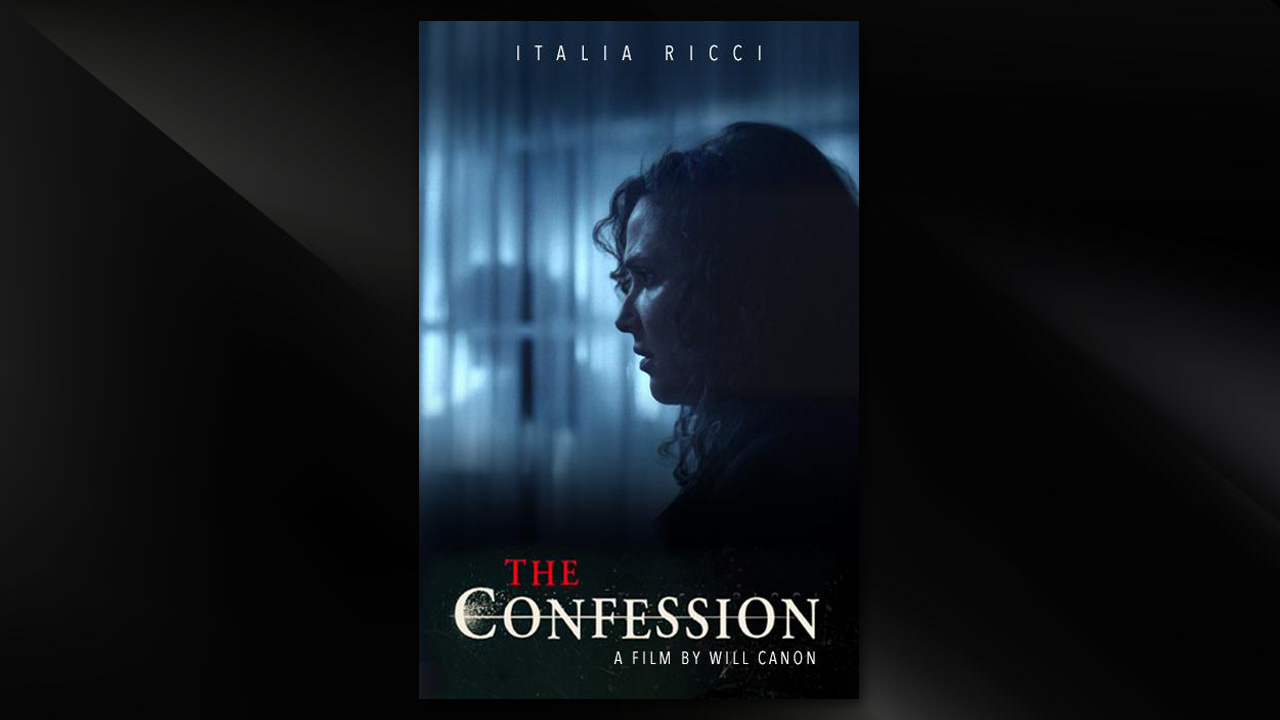
Will Canon’s last film entry was Demonic back in 2015, and ten years later he’s brought us The Confession. Recently, this chilling film rooted in the haunted soil of East Texas premiered at the Dallas International Film Festival and seems to be a powerful return for the Texas native.
But The Confession is more than just a return to form and a return home. It’s a thematic dive into East Texas. Canon’s story hits particularly close to home for me. As a native East Texan, I grew up surrounded by the same small-town religiosity, family secrets, and thick piney atmosphere that permeates throughout The Confession. There’s a certain quiet unease that hangs in the air.
It’s not just what people say. It’s what they don’t.
Seeing the church politics, generational tension, and the superstitions reveals what lingers beneath the surface.
Even though this movie is true horror, Canon didn’t make a caricature out of East Texas. There is restraint and authenticity. Whether it’s the way characters speak, or the moral ambiguity tied up in faith and family, it felt honest. It’s rare for a horror film to reflect a region like this without turning it into a cartoon.
In East Texas, stoicism is mistaken for strength and personal burdens are carried in silence. People make decisions rooted in duty, faith, and familial obligation. In reality, that quiet resolve comes at a cost. When emotions go unspoken and past traumas remain buried, choices are made not through open dialogue but through instinct. Choices feel right in the moment, but carry heavy, unforeseen consequences. The Confession taps into this. Canon shows how silence and sacrifice, while noble on the surface, can open the door to darkness.
“I was born in Lufkin,” Canon says. “There’s a different kind of lore in East Texas… It had to be there.”
The Confession follows Naomi, played by Italia Ricci, a struggling musician who returns with her young son to her childhood home in East Texas. There, she discovers a taped confession from her recently deceased father. He was a preacher, his words lead to a story that spirals out of control. Soon Naomi’s son exhibits strange behavior, and the past bubbles to the surface.
“It wasn’t just about horror,” Canon explains. “It was about grief, unanswered questions, the way we try to understand those we’ve lost.” He drew deeply from personal experiences, particularly the death of his father in 2020.
“Naomi’s journey to fill in the blanks of who her father really was—that came from something real.” Actor Scott Mechlowicz, who previously starred in Canon’s Demonic (2015), felt a deep connection to the material.
“The writing really helped anchor the performances,” Mechlowicz said. “It gave us somewhere to go emotionally.”
While The Confession taps into genre classics like The Exorcist, The Omen, and Sinister, Canon avoids falling into familiar horror traps. Instead, he favors realism. Ricci brought her own grounded realism to Naomi, a woman whose skepticism is tested as her maternal instincts clash with the inexplicable.
“I don’t think I could have done this role the same way before becoming a mom,” she says. “There’s this desperation to protect your child… I just had to imagine something happening to my son. That was enough. It felt like real life. You don’t always get answers. You don’t always get peace. Sometimes you’re left with more questions. And as a parent, that’s terrifying.”
She felt the frustration in a real way and this made the acting very easy.
Canon encouraged the actors to play out scenes as they would in real life. This process continued even in the face of events they couldn’t explain rationally. How could a person rationally grapple with the grim discovery of recorded grisly confessions? Instead of relying on gimmicks or tonal shifts, Canon uses these recordings as an emotional spine. “Naomi listens to it over and over, looking for clues. It felt more grounded and honest that way,” Canon said. As the characters revisited the tapes and learned more about what was happening, Canon and cinematographer John Rutland crafted a slow-burning descent into dread. The effects are subtle overall, but as the story progresses Canon and Rutland seep away the warmer tones and the characters’ world becomes colder and darker. Canon said water played a key component in the film’s visuals and he wanted to showcase this.
By the end, the audience reaches the story’s climax that shocks like the first plunge in icy waters. What they learn lands like a punch to the gut. Canon doesn’t want to spoil anything, but he recalls horror movies that influence him don’t have happy endings. “The Exorcist, The Shining, and Sinister … Sinister especially … I liked that it felt cinematic in a way that others didn’t,” Canon said “The mystery and emotional dread built up in a really smart way. I love a horror film that isn’t afraid to go dark at the end.” Canon believes directors shouldn’t try to tie everything neatly together.
Mechlowicz added that there is an emotional weight in the ambiguity at the end of The Confession. He said it gave the actors more to work with. Ricci echoed that sentiment. “Sometimes it’s more powerful when it doesn’t all work out,” Ricci says. “You’re left with more questions. And as a parent, that’s terrifying.”