

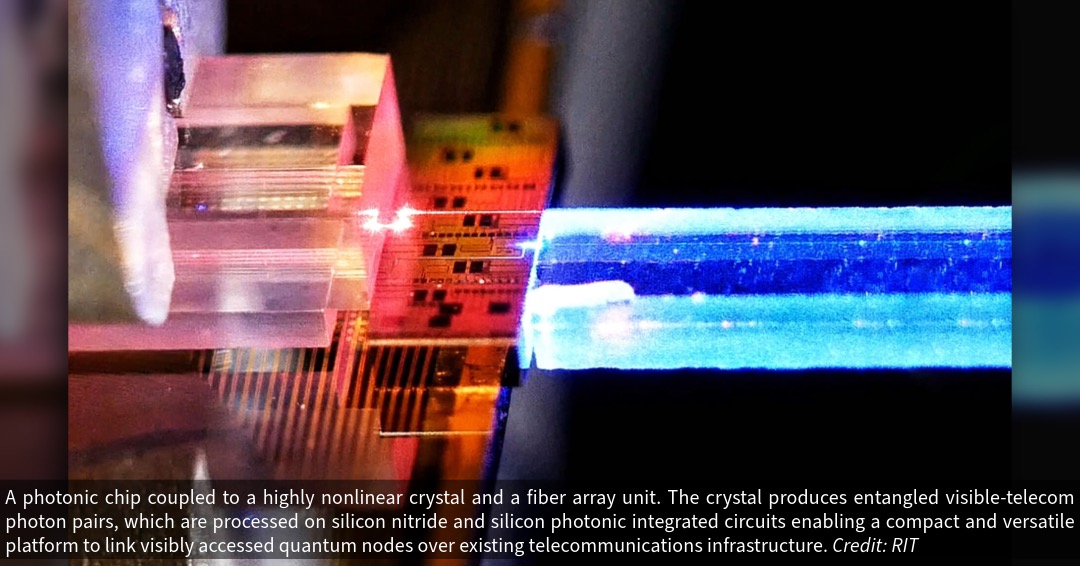
Researchers at the University of Rochester and Rochester Institute of Technology recently connected their campuses with an experimental quantum communications network using two optical fibers. In a new paper published in Optica Quantum, scientists describe the Rochester Quantum Network (RoQNET), which uses single photons to transmit information about 11 miles along fiber-optic lines at room temperature using optical wavelengths.
Quantum communications networks have the potential to massively improve the security with which information is transmitted, making messages impossible to clone or intercept without detection. Quantum communication works with quantum bits, or qubits, that can be physically created using atoms, superconductors, and even in defects in materials like diamond. However, photons — individual particles of light — are the best type of qubit for long distance quantum communications.
Photons are appealing for quantum communication in part because they could theoretically be transmitted over existing fiber-optic telecommunications lines that already crisscross the globe. In the future, many types of qubits will likely be utilized because qubit sources, like quantum dots or trapped ions, each have their own advantages for specific applications in quantum computing or different types of quantum sensing. However, photons are the most compatible with existing communications lines. The new paper is focused on making quantum communication between different types of qubits in a network a reality.
“This is an exciting step creating quantum networks that would protect communications and empower new approaches to distributed computing and imaging,” says Nickolas Vamivakas, the Marie C. Wilson and Joseph C. Wilson Professor of Optical Physics, who led the University of Rochester’s efforts. “While other groups have developed experimental quantum networks, RoQNET is unique in its use of integrated quantum photonic chips for quantum light generation and solid-state based quantum memory nodes.”
The teams at the University of Rochester and RIT combined their expertise in optics, quantum information, and photonics to develop technology with photonic-integrated circuits that could facilitate the quantum network. Currently, efforts to leverage fiber-optic lines for quantum communication require bulky and expensive superconducting-nanowire-single-photon-detectors (SNSPDs), but they hope to eliminate this barrier.
“Photons move at the speed of light and their wide range of wavelengths enable communication with different types of qubits,” says Stefan Preble, professor in the Kate Gleason College of Engineering at RIT. “Our focus is on distributed quantum entanglement, and RoQNET is a test bed for doing that.”
Ultimately, the researchers want to connect RoQNET to other research facilities across New York State at Brookhaven National Lab, Stony Brook University, Air Force Research Laboratory, and New York University.
The research was supported by Air Force Research Laboratory.
From ScienceDaily.com