

One of my favorite themes to explore in stories is time: how individuals, ideas, and places change as it relentlessly marches forward, whether it’s across centuries or a single night. Much like me, director Richard Linklater shares this obsession. The way people fill it with talk, regrets, and what-ifs. From the existential drifting of Waking Life, to the late-night intimacy of Before Sunset, he’s built a career out of making conversation cinematic. With Blue Moon, he takes that obsession to the stage literally by crafting a chamber piece that traps one man in a single night, one room, and a lifetime’s worth of unfinished lyrics.
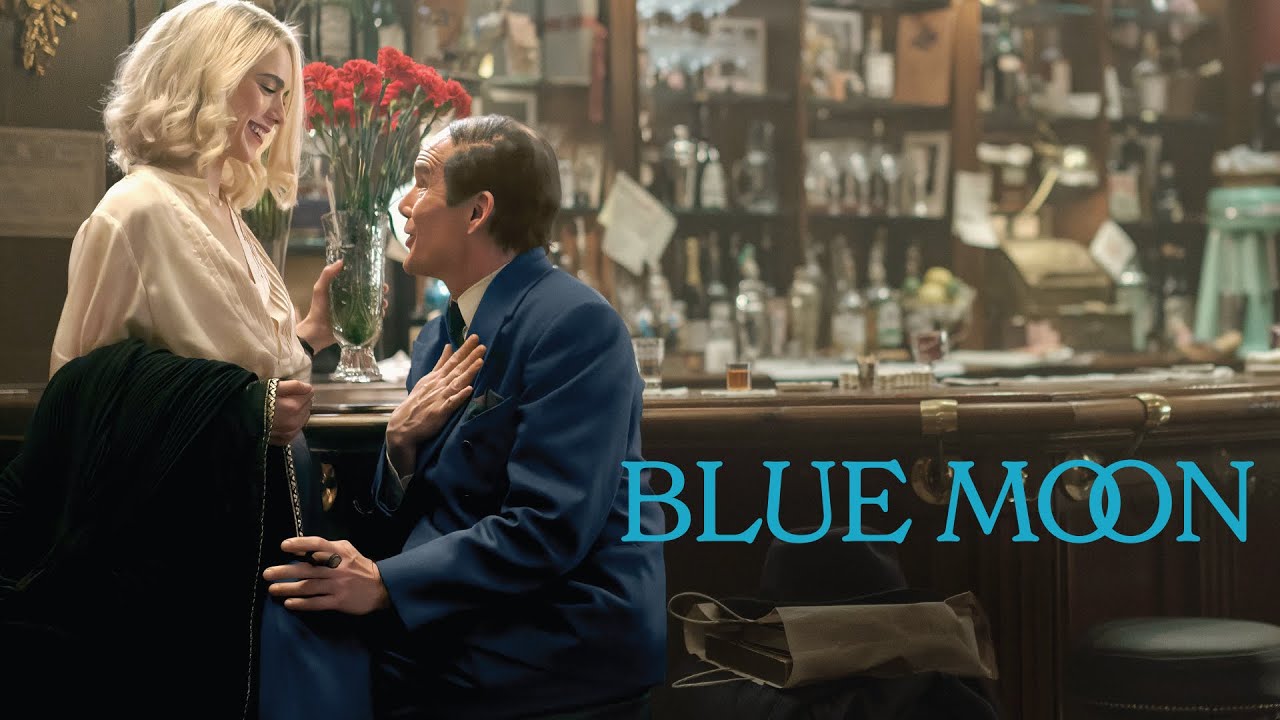
Set in 1943, the film follows Lorenz Hart (Ethan Hawke), the former lyricist partner of composer Richard Rodgers (Andrew Scott). It’s the night of Oklahoma!’s premiere, and while Rodgers is off basking in the glow of his new collaboration with Oscar Hammerstein (Simon Delaney), Hart has already escaped to the bar that will eventually host the premier party. Over the course of a few hours, he bounces between patrons, colleagues, and bar staff, unspooling his genius, his insecurities, and his loneliness in a flurry of words. The entire film takes place within this bar, but Linklater makes it feel expansive, as if Hart’s voice yearns to fill every empty theater seat in America if only someone would listen long enough.
If that sounds stagey, it is, and proudly so. Blue Moon is a film built out of conversation and cadence (admittedly a dream for theatre kids such as myself). It’s not interested in plot; it’s interested in presence. Linklater’s camera rarely cuts away, lingering instead on Hawke’s face as he ricochets from wit to despair, and five topics later, back to square one again. The director knows how to make talk feel like motion. The verbal rhythm itself becomes the film’s choreography. And the real challenge here is Hart’s manic, ADHD-like speech patterns never allow me to fully predict where his thought process will land next.
I’ll admit, I didn’t know much about Lorenz Hart going in beyond being the “before Hammerstein” half of Rodgers & Hart. But that ignorance actually works in the film’s favor. Like many viewers, I meet him not as a historical figure but as a person spiraling through his own contradictions: a man who can’t stop performing, even when he’s his own toughest audience. Through his torrent of dialogue, we learn about his bisexuality, his insecurities about his height and looks, his creative brilliance, and his battle with alcoholism. And most prominently, his obsession and complicated pseudo-relationship with a twenty year old college student named Elizabeth Weiland (Margaret Qualley.) Yet none of it feels expositional; it just spills out of him the way a song might if he still believed in writing them.
Ethan Hawke plays Hart as a paradox made flesh; manic one second, maudlin the next. It’s the kind of performance that could have veered into caricature, but Hawke has this uncanny ability to make self-destruction magnetic. His Hart is the loudest man in the room and the loneliest at the same time. You can feel him searching for connection through every quip and drunken boast. There are moments where I found myself deeply annoyed by him, and immediately after, completely gutted with pity. Hawke walks that emotional tightrope without a wobble.
The film’s structure reinforces a sense of entrapment. Conversations loop back on themselves, jokes repeat with slightly different inflections, confessions get half-walked-back and rephrased. It’s the way drunk people talk, but also the way guilty and lonely people think – cycling through the same stories, trying to rewrite them in real time. You start to realize that Hart’s endless talking isn’t about connection; it’s a defense mechanism against silence. Because silence, for him, means living with himself.
What surprised me most was how emotionally cumulative the film becomes. For a while, you’re just riding the rhythm of Hart’s pattern, admiring the wordplay and wincing at the arrogance, and then suddenly, it sneaks up and breaks your heart. There’s a moment (no spoilers) when Hart admits something devastatingly simple, and for once, he stops talking. Linklater lets the silence linger. It’s like watching a candle finally burn out.
Blue Moon isn’t going to be for everyone. It’s uncomfortable, verbose, theatrical, and absolutely uninterested in conventional storytelling. But for those who connect with Linklater’s fascination with talk as truth (or with Hawke’s ongoing exploration of broken, beautiful men), it’s mesmerizing. It’s also, in its own strange way, one of the best “biopics” about art I’ve seen in years precisely because it refuses to act like one. Instead of flattening its subject into a three-act structure, it just lets him live and unravel in real time. And that very tiny window of time we get to peer into this man’s life is incredibly effective. By the time Hart’s night (at this bar) ends, you realize you’ve spent nearly two hours watching a man talk himself into oblivion, and you can’t look away. Blue Moon is a movie about a very small moment in time when we see a man of immense talent come to a crossroad between self destruction and redemption.