

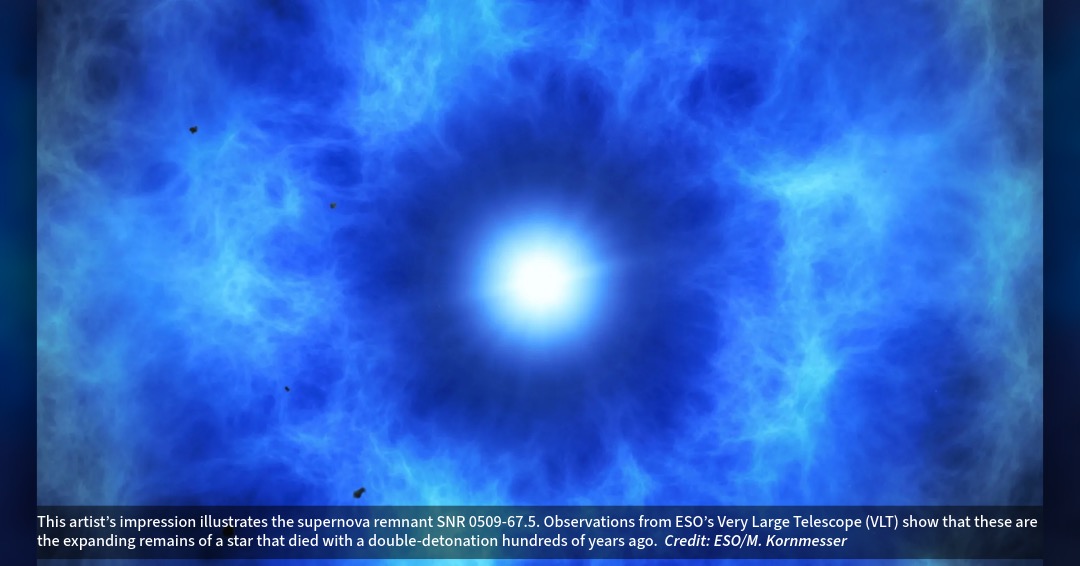
For the first time, astronomers have obtained visual evidence that a star met its end by detonating twice. By studying the centuries-old remains of supernova SNR 0509-67.5 with the European Southern Observatory’s Very Large Telescope (ESO’s VLT), they have found patterns that confirm its star suffered a pair of explosive blasts. Published today, this discovery shows some of the most important explosions in the Universe in a new light.
Most supernovae are the explosive deaths of massive stars, but one important variety comes from an unassuming source. White dwarfs, the small, inactive cores left over after stars like our Sun burn out their nuclear fuel, can produce what astronomers call a Type Ia supernova.
“The explosions of white dwarfs play a crucial role in astronomy,” says Priyam Das, a PhD student at the University of New South Wales Canberra, Australia, who led the study on SNR 0509-67.5 published today in Nature Astronomy. Much of our knowledge of how the Universe expands rests on Type Ia supernovae, and they are also the primary source of iron on our planet, including the iron in our blood. “Yet, despite their importance, the long-standing puzzle of the exact mechanism triggering their explosion remains unsolved,” he adds.
All models that explain Type Ia supernovae begin with a white dwarf in a pair of stars. If it orbits close enough to the other star in this pair, the dwarf can steal material from its partner. In the most established theory behind Type Ia supernovae, the white dwarf accumulates matter from its companion until it reaches a critical mass, at which point it undergoes a single explosion. However, recent studies have hinted that at least some Type Ia supernovae could be better explained by a double explosion triggered before the star reached this critical mass.
Now, astronomers have captured a new image that proves their hunch was right: at least some Type Ia supernovae explode through a ‘double-detonation’ mechanism instead. In this alternative model, the white dwarf forms a blanket of stolen helium around itself, which can become unstable and ignite. This first explosion generates a shockwave that travels around the white dwarf and inwards, triggering a second detonation in the core of the star — ultimately creating the supernova.
Until now, there had been no clear, visual evidence of a white dwarf undergoing a double detonation. Recently, astronomers have predicted that this process would create a distinctive pattern or fingerprint in the supernova’s still-glowing remains, visible long after the initial explosion. Research suggests that remnants of such a supernova would contain two separate shells of calcium.
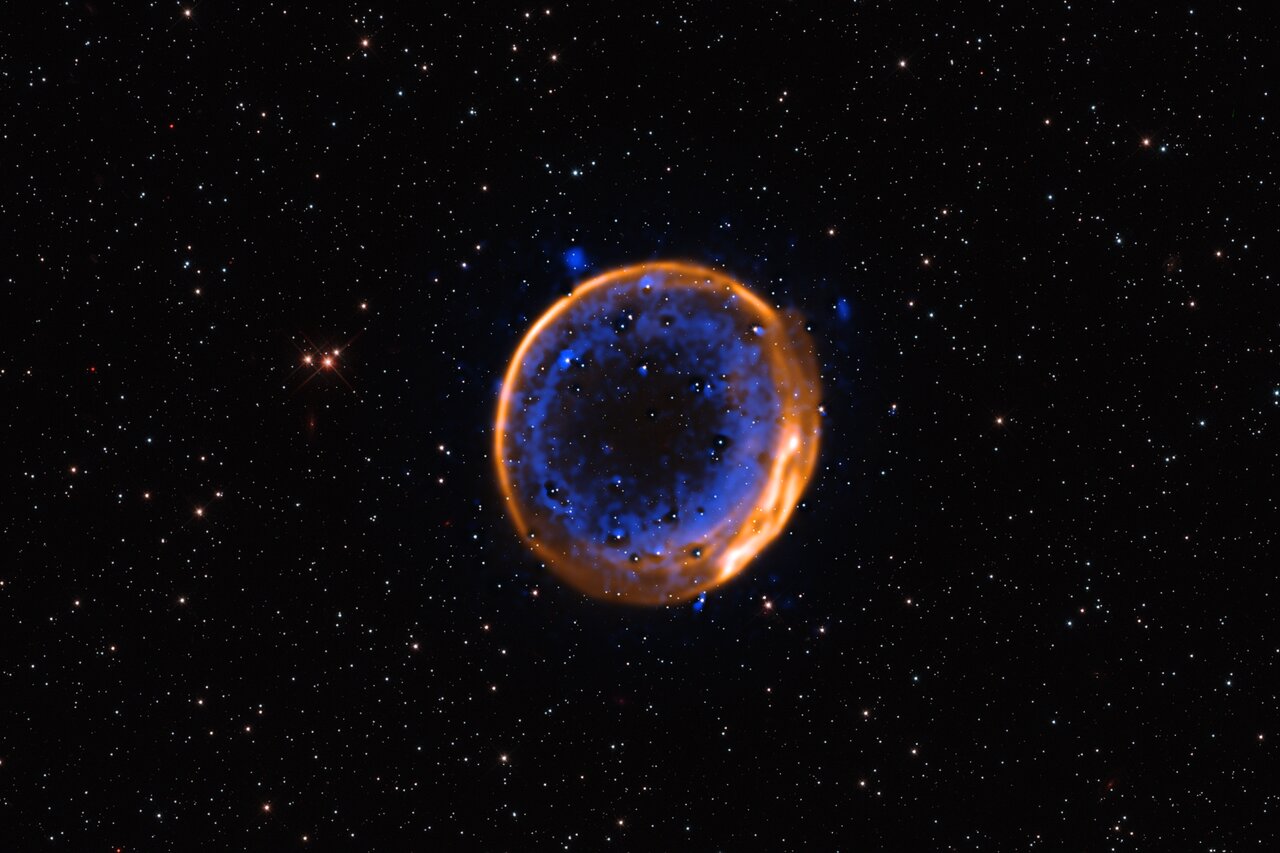
Astronomers have now found this fingerprint in a supernova’s remains. Ivo Seitenzahl, who led the observations and was at Germany’s Heidelberg Institute for Theoretical Studies when the study was conducted, says these results show “a clear indication that white dwarfs can explode well before they reach the famous Chandrasekhar mass limit, and that the ‘double-detonation’ mechanism does indeed occur in nature.” The team were able to detect these calcium layers (in blue in the image) in the supernova remnant SNR 0509-67.5 by observing it with the Multi Unit Spectroscopic Explorer (MUSE) on ESO’s VLT. This provides strong evidence that a Type Ia supernova can occur before its parent white dwarf reaches a critical mass.
Type Ia supernovae are key to our understanding of the Universe. They behave in very consistent ways, and their predictable brightness — no matter how far away they are — helps astronomers to measure distances in space. Using them as a cosmic measuring tape, astronomers discovered the accelerating expansion of the Universe, a discovery that won the Physics Nobel Prize in 2011. Studying how they explode helps us to understand why they have such a predictable brightness.
Das also has another motivation to study these explosions. “This tangible evidence of a double-detonation not only contributes towards solving a long-standing mystery, but also offers a visual spectacle,” he says, describing the “beautifully layered structure” that a supernova creates. For him, “revealing the inner workings of such a spectacular cosmic explosion is incredibly rewarding.”
This research was presented in a paper to appear in Nature Astronomy titled “Calcium in a supernova remnant shows the fingerprint of a sub-Chandrasekhar mass explosion.”
The team is composed of P. Das (University of New South Wales, Australia [UNSW] & Heidelberger Institut für Theoretische Studien, Heidelberg, Germany [HITS]), I. R. Seitenzahl (HITS), A. J. Ruiter (UNSW & HITS & OzGrav: The ARC Centre of Excellence for Gravitational Wave Discovery, Hawthorn, Australia & ARC Centre of Excellence for All-Sky Astrophysics in 3 Dimensions), F. K. Röpke (HITS & Institut für Theoretische Astrophysik, Heidelberg, Germany & Astronomisches Recheninstitut, Heidelberg, Germany), R. Pakmor (Max-Planck-Institut für Astrophysik, Garching, Germany [MPA]), F. P. A. Vogt (Federal Office of Meteorology and Climatology – MeteoSwiss, Payerne, Switzerland), C. E. Collins (The University of Dublin, Dublin, Ireland & GSI Helmholtzzentrum für Schwerionenforschung, Darmstadt, Germany), P. Ghavamian (Towson University, Towson, USA), S. A. Sim (Queen’s University Belfast, Belfast, UK), B. J. Williams (X-ray Astrophysics Laboratory NASA/GSFC, Greenbelt, USA), S. Taubenberger (MPA & Technical University Munich, Garching, Germany), J. M. Laming (Naval Research Laboratory, Washington, USA), J. Suherli (University of Manitoba, Winnipeg, Canada), R. Sutherland (Australian National University, Weston Creek, Australia), and N. Rodríguez-Segovia (UNSW).
From ScienceDaily.com