

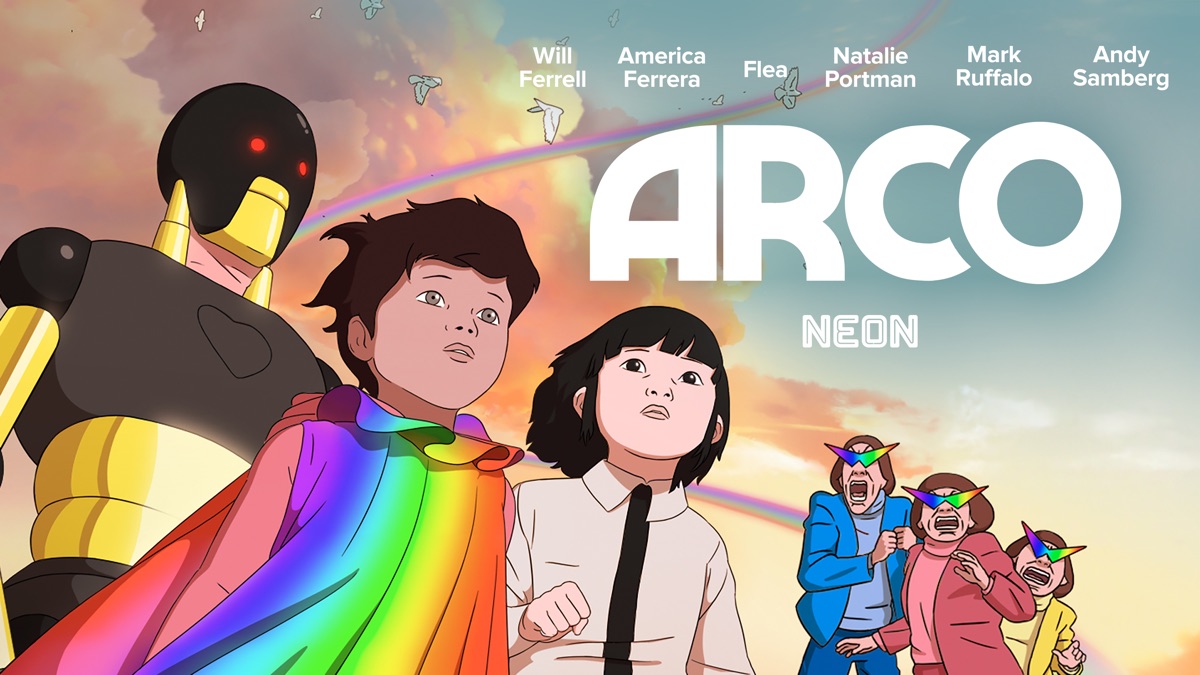
What has always made me a lifelong animation nerd is a sense of awe at what the medium can accomplish. Live-action cinema has achieved remarkable things—especially with the rise of CGI, which is arguably animation in its own right—but animation remains the form that most consistently pushes the limits of imagination on screen. Some films do this through maximalism, exuberance, music, and expression (KPop Demon Hunters, which I adore, being a prime example.) Others find their power in restraint. Arco belongs firmly to the latter category, asking its audience not to anticipate where it is going, but to remain present with where it is.
Directed by Ugo Bienvenu and Gilles Cazaux, Arco is a French, hand-drawn 2D animated film centered on Iris (Romy Fay), a lonely girl living in the year 2075. Her life is disrupted when Arco (Juliano Valdi), a strange boy who falls from the sky on a rainbow, quite literally lands in her world. Iris soon learns that Arco comes from a distant future where people live in houses suspended above the Earth, and that he has time-traveled to her era by accident, against his parents’ wishes. As the two search for a way to send him home, they encounter obstacles ranging from environmental decay to three men obsessed with finding these so-called “rainbow people.”
In a landscape where CGI has become the norm (even within traditionally 2D animation), it is increasingly rare to see a fully hand-drawn film, especially one rendered with this level of care. Arco’s visuals alone are worth the price of admission. Given the importance of rainbows to the story, color does a great deal of narrative and emotional work, but what impressed me most was the film’s restraint in its use. Just as the palette threatens to become overwhelming, the film often pulls back into softer, muted tones, creating a kind of visual palate cleanser. The animation itself has a gentle, fluid quality, with a subtle motion-blur effect lending weight to its action sequences. As an animation enthusiast, I also found myself lingering on the environmental details—something I haven’t seen handled this lovingly in traditional animation since The Boy and the Heron.
It’s impossible to discuss Arco without acknowledging the influence of Hayao Miyazaki. The film borrows liberally from his playbook: in its art direction, pacing, environmental themes, and even certain musical cues. This is not meant as a criticism. In less capable hands, such influence could have resulted in something derivative or hollow. Instead, Bienvenu and Cazaux demonstrate a deep understanding of what gives Miyazaki’s films their soul, looking beyond surface aesthetics to capture a similar sense of quiet wonder and emotional sincerity—while still allowing Arco to maintain its own identity.
This brings me to what I consider Arco’s defining strength: its restraint. The film embraces a “show, don’t tell” approach that feels increasingly rare in family-oriented animation. While this makes for a rich and rewarding experience, it may prove challenging for some younger viewers. Despite their youth, the central characters possess a maturity that may not immediately resonate with all children. That said, Mikki (brilliantly voiced by both Natalie Portman and Mark Ruffalo) as Iris’s robot nanny—provides a welcome emotional anchor and a touch of warmth. Meanwhile, Dougie, Stewie, and Frankie (voiced by Will Ferrell, Andy Samberg, and Flea), the trio obsessed with tracking the rainbow visitors, strike a note of absurdity that feels distinctly European in tone: broad, strange, and unapologetically odd. Ultimately, I’m always glad to see passionate animators given the resources to create something as distinctive as Arco, particularly in the increasingly endangered realm of hand-drawn animation. While it may not offer fast-paced spectacle, the film delivers a contemplative experience that left me with a quiet, melancholic sense of joy. I look forward to seeing what its creators do next.