

Small, remote islands were long thought to have been the last frontiers of pristine natural systems.
Humans are not thought to have been able to reach or inhabit these environments prior to the dawn of agriculture, and the technological shift that accompanied this transition.
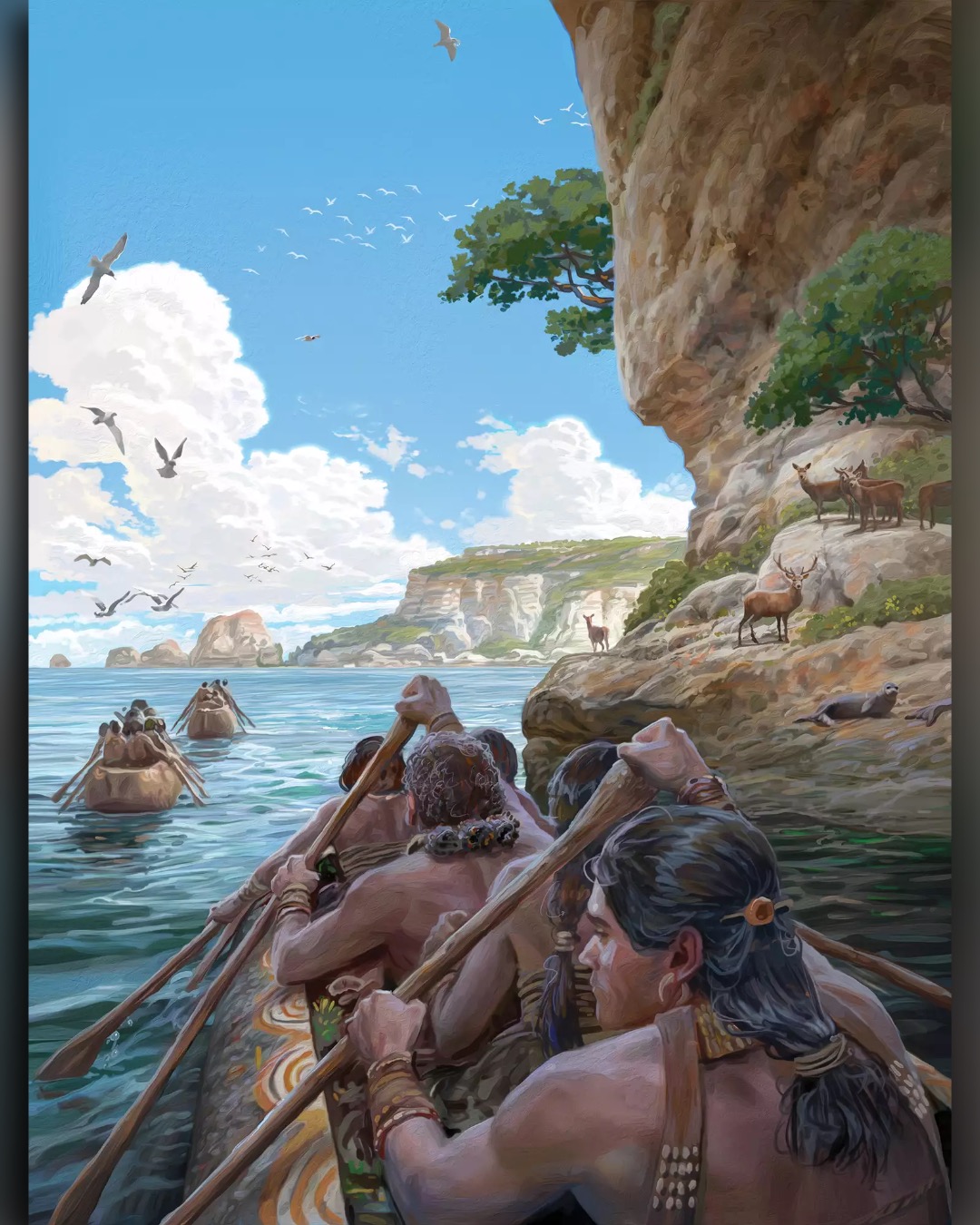
In a paper published in Nature, new evidence shows that hunter-gatherers were crossing at least 100 kilometers (km) of open water to reach the Mediterranean island of Malta 8,500 years ago, a thousand years before the arrival of the first farmers.
This report documents the oldest true long-distance seafaring in the Mediterranean, before the invention of boats with sails — an astonishing feat for hunter-gatherers likely using simple dugout canoes.
“Relying on sea surface currents and prevailing winds, as well as the use of landmarks, stars, and other wayfinding practices, a crossing of about 100 km is likely, with a speed of about 4 km per hour. Even on the longest day of the year, these seafarers would have had over several hours of darkness in open water,” explains Professor Nicholas Vella of the University of Malta, co-investigator of the study.
The discoveries were made by a scientific consortium led by Professor Eleanor Scerri of the Max Planck Institute of Geoanthropology (MPI-GEA) and the University of Malta.
At the cave site of Latnija in the northern Mellieħa region of Malta, the researchers found the traces of humans in the form of their stone tools, hearths, and cooked food waste.
“We found abundant evidence for a range of wild animals, including Red Deer, long thought to have gone extinct by this point in time,” explains Prof. Scerri. “They were hunting and cooking these deer alongside tortoises and birds, including some that were extremely large and extinct today.”
In addition to this, the team of researchers found clear evidence for the exploitation of marine resources.
“We found remains of seal, various fish, including grouper, and thousands of edible marine gastropods, crabs and sea urchins, all indisputably cooked,” adds Dr James Blinkhorn of the University of Liverpool and MPI-GEA, one of the study’s corresponding authors.
These discoveries also raise questions about the extinction of endemic animals on Malta and other small and remote Mediterranean islands, and whether distant Mesolithic communities may have been linked through seafaring.
“The results add a thousand years to Maltese prehistory and force a re-evaluation of the seafaring abilities of Europe’s last hunter-gatherers, as well as their connections and ecosystem impacts,” adds Prof. Scerri.
The research was supported by Malta’s Superintendence of Cultural Heritage, and funded by the European Research Council and the University of Malta’s Research Excellence Award
From ScienceDaily.com
Featured Image:
Hunter-gatherers were crossing at least 100 km of open water to reach the Mediterranean island of Malta 8,500 years ago, a thousand years before the arrival of the first farmers.
© Daniel Clarke/ MPI GEA