

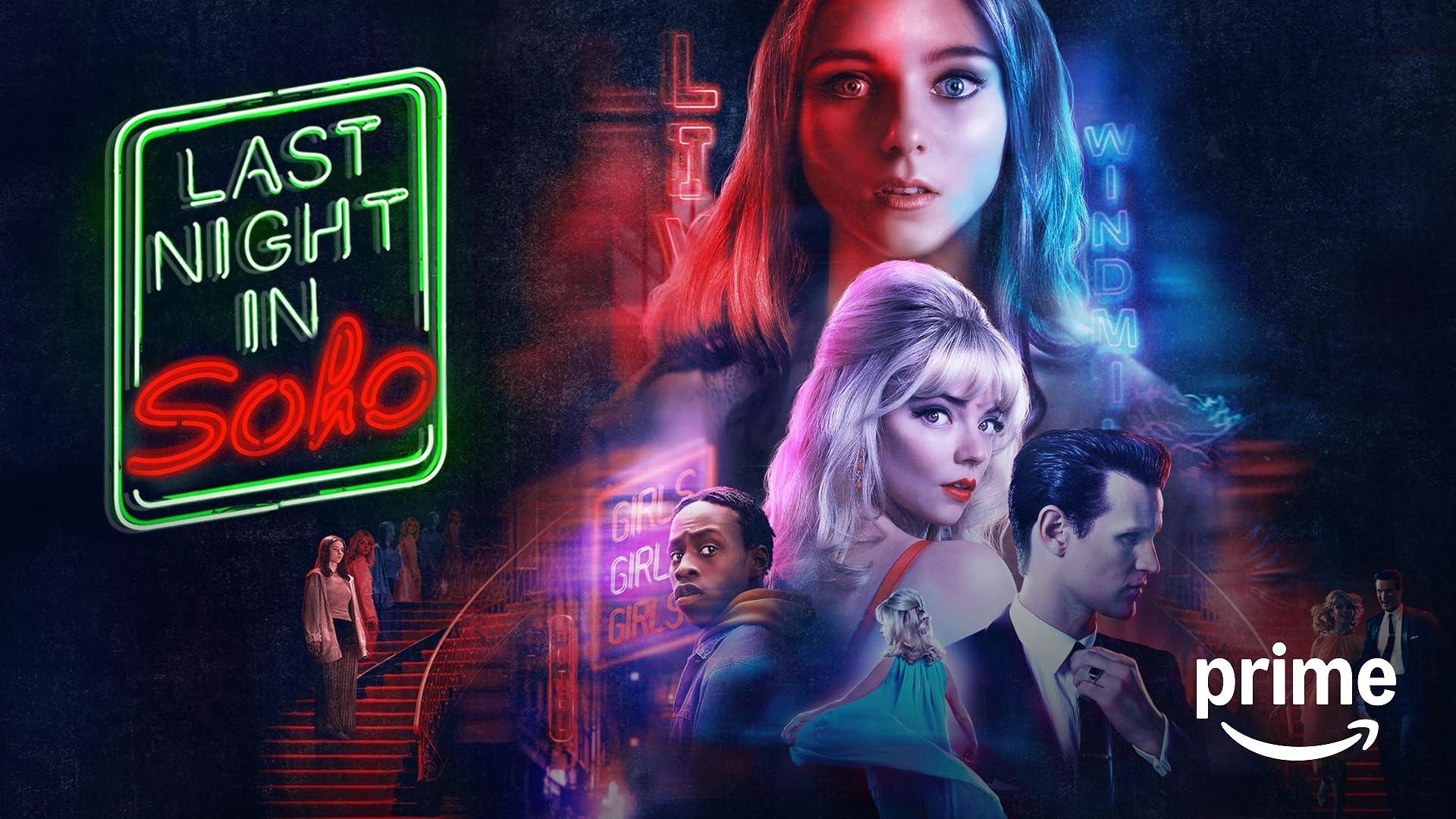
Coming out of the theaters from seeing Last Night In Soho last November, I was certain: this was Edgar Wright’s greatest film to date. Quite a bold statement, so know, coming from a cinefile
and long established fangirl of the director such as myself. Yet there I was, certain as anything that this was not only his best film, but my vote for 2021’s best movie of the year. One exhausting holiday season later, and I’m slightly doubting myself. Was I just caught in the high of seeing a much anticipated (and a bit delayed in release due to COVID-19) film by one of my favorite directors? Sometimes seeing the “newest” of anything can have that blinding effect in one’s judgment as emotions are high, memories are fresh, and that popcorn and candy are hitting your bloodstream juuuust right to kick off those happy brain juices. Last Night In Soho follows Eloise (Thomasin McKenzie), a young fashion student, and ardent enthusiasts for anything from the
1960’s era. Eloise additionally is “gifted” in another way: she can see things other people can’t, including visions of the past, and even a few ghosts. When she is given the opportunity to study fashion in the posh Soho neighborhood in London, Eloise begins to see vivid visions of the past in her new flat. At first, she’s absolutely enchanted by them, as the visions center around Sandie (Anya- Taylor Joy) a beautiful aspiring singer Pershing her stardom in the 1960s. However, Eloise eventually learns that Sandie’s life, as well as the entire era she once idolized, were far less glamorous than they originally seemed. What was it about this film that made me immediately latch on to it so? Visually, it was absolutely stunning. Everything from the lighting, the juxtaposition of the past and present, meaningful framing, and even the brightly bold color palette had a positively dizzying effect on the senses. It’s not only beautiful to look at, but practically a sensory overload, giving a sense of confusion and uneasiness.
Perhaps in a happier film, this may have been detrimental, but for this film’s intended mood, it’s perfect. Not only are the visuals a lot to take in, but the sounds in this film are every bit as important. Musical cues are one of the driving factors of the story here, as we’re treated (very loudly I might add) to veritable “best of” the music of the 1960’s. Perhaps it’s my bias showing, because like Eloise, I’ve always worshiped music from this era. Using music in this way is no new trick for Wright, however, as several of his films notably do the same (Scott Pilgrim Vs The World and Baby Driver being the most glaring examples.) Is using great music to flavor your movie just a cheap way of making it seem like it’s good? Song selection per scene is still extremely important, yet no easy task. Also, editing the timing of the music to match the “beats” of your scene can take an expert eye and ear.
Is it perhaps the horror element that draws me to this film? Again, Wright is no stranger to the genre, as both psychological and supernatural horror elements are heavy in his “Cornetto Trilogy” films. But unlike the horror in those, the disturbing parts in Last Night in Soho are taken 100% seriously — and by the end I was really feeling them. I think here is where some could find criticism with this film. Wright lingers almost overly long on the more unsettling elements of the movie, perhaps to the point where some would feel like he is overselling it. This is one move I find very different for the director, as I would often describe Wright’s preferred directing style as ADHD in the best way possible. Maybe I wouldn’t like it for everything, but I appreciated Wright taking the extra time with some scenes in this one to really drive in the point. It’s extremely important that by the end we experience and empathize with what Eloise is going through.
I think in the end, I’m still going to maintain that Last Night in Soho is still the best Edgar Wright film to date, but also concede that part of it may be due to personal taste. While he’s great at
writing strong female characters, this is his first film truly from a “female” perspective. I hate to bring in feminism or even harder to discuss topics into this, but this film really does a brilliant job of illustrating how scary it can be to be a woman in a world of hidden predatory men. I’m not saying women should all feel scared about this, but most of us have felt this kind of scared at some point and it’s absolutely valid. Something else I relate far too much about this is my idolization of the past (something I address nearly every time I review a period piece.) Eloise learns that no time
period was ideal, even if superficial things like music and fashion are better. Much like the main character, I get stuck pining a time and place that isn’t my own, and my present tends to suffer for it. Whether or not Last Night in Soho is the best Edgar Wright film is purely objective, of course. But nevertheless, it’s undeniably another great entry in his repertoire of wildly entertaining films.