

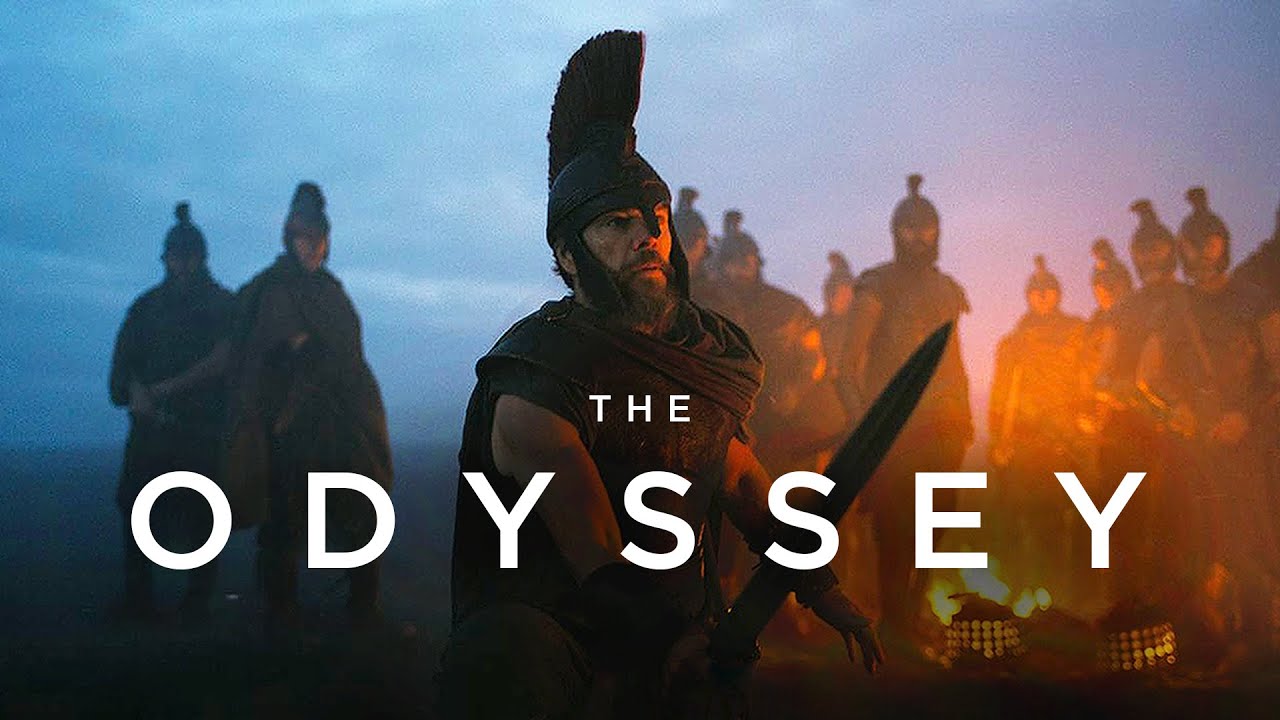
I was dreading seeing this film. Not because I don’t trust Christopher Nolan (I still stand behind the 10/10 grade I gave Interstellar), not because I can’t handle a three hour long epic. And certainly not because I bought into the negative discourse spreading online about it for months. No, I was only dreading to see The Odyssey because as a Greek Mythology nerd since my single digits, I’m picky when it comes to interpretations of the myths. I’ll be the first to obnoxiously point out what went wrong. As I’ve become older and a tad bit wiser, I’ve come to peace with media taking some liberties with the stories. Some. I say that conservatively, as yes – Circe could have the wrong eye color, or Hermes could be wearing Air Jordans and playing an electric guitar made out of a tortoiseshell, and that would be acceptable within reason. But Greek Mythology is deeply rooted in philosophy. And if an adaptation gets 85% of the technical details of a myth right, but completely misinterprets the meaning, I immediately disregard it. And let’s face it, Homer’s epic poem is dense and can leave much room for error. Even for those who actually did enjoy covering it in middle school literature class.
Christopher Nolan gallantly takes on the epic challenge of adapting this behemoth to the big screen, and he spares none of the usual tools in his arsenal. Like the poem, much of The Odyssey is told to us through story. After the events of the Trojan War, Odysseus, king of Ithaca (Matt Damon) is eager to get home to his beloved wife Penelope. Unfortunately, the journey across the sea proves to be increasingly arduous for him and his men. Meanwhile, back in Ithaca, Queen Penelope (Anne Hathaway) is contending with the horde of suitors who have taken over her halls, insisting her husband must surely be dead by now as he has not returned in nearly ten years since the war ended. This puts an increasing amount of pressure on their son, Telemachus (Tom Holland) to protect himself and his mother from these dangerous men, while living in the shadow of the father he never got to meet. The film bounces between Odysseus’s journey, the happenings in Ithaca, as well as flashbacks straight from the Iliad covering the important events of the Trojan War.
I’m happy Nolan took a project of this scale at this point in his career. As I’ve said, he spares none of his usual tools, but now they are sharpened from experience. He has learned when technique must go beyond spectacle. Something that has always wow’ed me about his film making is his use of space and scale. Particularly the vastness as a pressure system to show how small and exposed a person can be in comparison, juxtaposed with that claustrophobia inducing small spaces that turns that vastness inward. Every penny of the IMAX 70mm camera Nolan insisted on was put to good use when beholding the spectacle of a shipwrecked beach, a misty forest, an endless sea. And conversely inside the infamous Trojan Horse, I can almost feel the heat, the disgusting smells, the cramps.
As much as Nolan puts an emphasis on visuals, he insists just as much on sound to convey his message. I will mention the impressive score by Oscar winner Ludwig Göransson which was composed entirely of ancient Greek instruments. It was perfect and will likely garner Göransson another Oscar nomination. But then of course, we have the sound mixing, something Nolan is notoriously heavy handed with at times. While I certainly agree that is the case in many of his recent films and he didn’t have a light hand in this one either, it was far more justified this time around. The eerie voice of the Cyclops Polyphemus, the near silence as the crew puts wax in their ears as they sail past the Sirens. The mere twang of Odysseus’s bowstring that he feels compelled to do before using it. Everything was mixed for maximum immersion, so much so that I got chills at times – and not from the cinema AC.
Like many accomplished directors, Nolan relies heavily on actors he has worked with before and trusts. While in many cases, that can prove to be a film’s undoing as directors may overlook genuine talent for favoritism. I’ll admit I had this concern as well, seeing the heavily A-lister stacked cast list (Like… scream queen Mia Goth plays Melantho, a slave girl with a few minutes of screen time?) But what separates a mediocre director from a great one is how they utilize their A-listers. Sure, everyone in this film has already proven to be talented actors in other works, but Nolan excels in taking them to an even higher caliber than before. Damon has often been a featured side player in Nolan’s films, but is truly proving his abilities as a lead. His Odysseus is all at once haunted, grieving, noble, warm, and proud – exactly how I envisioned the character. Likewise, Hathaway’s Penelope provides the perfect homophrosyne (Homer’s descriptor of like-minded partnership) for him – playing her with a fierce, yet exhausted strength, yet a sharpness that intimidates anyone who dares cross her. I will also extend a small laurel wreath to Robert Pattinson as Antinous, the most aggressive suitor for Penelope. I have yet to see this man give a repeat performance in any of his works and in this case he plays a sniveling, backstabbing snot of a man, who I still somehow feel pity for.
While I had no doubt that Nolan would present us with a technical marvel of sight, sound, and performance, my apprehension was always in the heart of the story. Sure, we can get a play by play film that features Cyclops, a witch who turns sailors into animals, or a deadly whirlpool, resulting in a fun popcorn adventure film and nothing more. But I’m happy to say, Nolan’s understanding of not only the story, but the philosophy that existed as a foundation for it exist. Sure, the blinding of Polyphemus (who was Poseidon’s son) was the surface reason why Odysseus and crew faced so much challenge getting home. But then we learn throughout that Odysseus carried not just the miasma (the Greek idea of spiritual guilt) of his sin against Poseidon, but of the loss of his men’s lives as well as the ramifications for his actions in Troy. Each of these separate guilts must be addressed before he earns his ending. Speaking of endings, without spoiling too much, this film’s was the one aspect that Nolan took extra liberties with and made his own. But you know what? Nolan earned his very Nolan ending as it was the perfect payoff for every foundation he set in place. He gave us a beautiful Homer’s Odyssey 95% of the way through.
The Odyssey is instantly a contender for my top film so far this year. The nine year old me reading Greek Mythology books alone in the library as well as 22 year old me who crammed three Monsters to finish her ten page Greek Philosophy mid-term paper are both elated to have seen an adaptation so beautiful and terrifying, yet faithful to the source material in ways that truly matter most.