

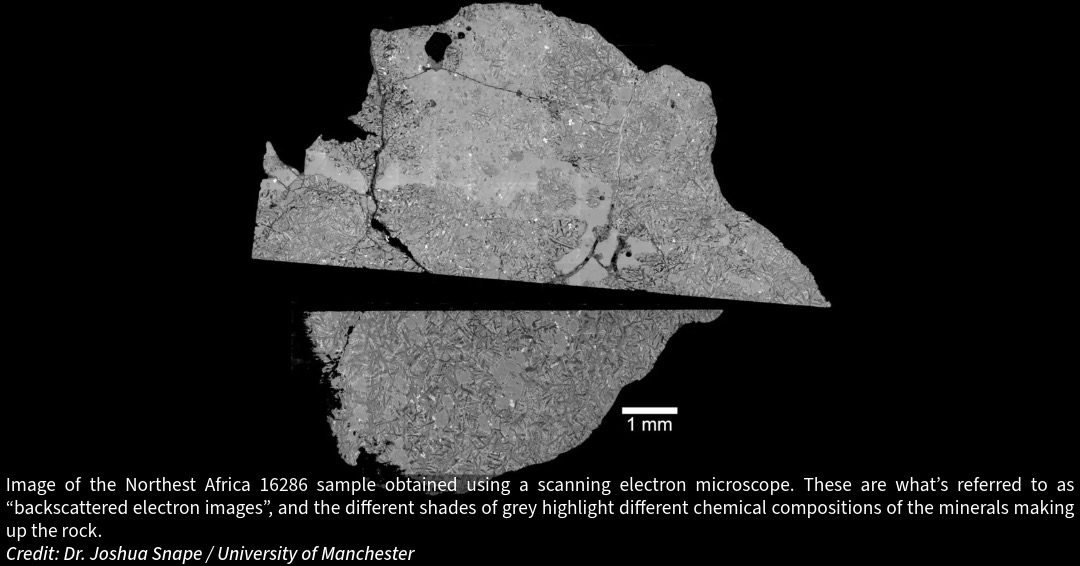
A 2.35-billion-year-old meteorite with a unique chemical signature, found in Africa in 2023, plugs a major gap in our understanding of the Moon’s volcanic history.
Findings from analyses of the Northwest Africa 16286 meteorite, presented at the Goldschmidt Conference in Prague, offer fresh insights into how the Moon’s interior evolved, highlighting the long-lived nature of its volcanic activity.
Analyses by researchers from the University of Manchester, UK, lend weight to a theory that the Moon retained internal heat-generating processes that powered lunar volcanic activity in several distinct phases.
Lead isotope analysis dates the rock’s formation to around 2.35 billion years ago, during a period from which few lunar samples exist, making it the youngest basaltic lunar meteorite discovered on Earth. Its rare geochemical profile sets it apart from those returned by previous Moon missions, with chemical evidence indicating it likely formed from a lava flow that solidified after emerging from deep within the Moon.
Dr Joshua Snape, a Research Fellow at the University of Manchester, UK, is presenting the research at the Goldschmidt Conference. He said: “Lunar rocks from sample return missions are fantastic in the insights they provide us, but they are limited to the immediate areas surrounding those mission landing sites. By contrast, lunar meteorites can potentially be ejected by impact cratering occurring anywhere on the Moon’s surface. As such, there’s some serendipity surrounding this sample; it just happened to fall to Earth and reveals secrets about lunar geology without the massive expense of a space mission.”
Containing relatively large crystals of mineral olivine, the rock is a type of lunar volcanic basalt called olivine-phyric basalt. It contains moderate levels of titanium, high levels of potassium. In addition to the unusual age of the sample, this study found that the Pb isotope composition of the rock – a geochemical fingerprint retained from when the rock formed – points to it originating from a source in the Moon’s interior with an unusually high uranium-to-lead ratio. These chemical clues may help identify the mechanisms that have enabled periods of ongoing internal heat generation on the Moon.
“The age of the sample is especially interesting because it fills an almost billion-year gap in lunar volcanic history,” said Dr Snape. “It’s younger than the basalts collected by the Apollo, Luna and Chang’e 6 missions, but older than the much younger rocks brought back by China’s Chang’e 5 mission. Its age and composition show that volcanic activity continued on the Moon throughout this timespan, and our analysis suggests an ongoing heat generation process within the Moon, potentially from radiogenic elements decaying and producing heat over a long period.
“Moon rocks are rare, so it’s always interesting when we get something that stands out and looks different to everything else. This particular rock provides new constraints about when and how volcanic activity occurred on the Moon. There is much more yet to learn about the Moon’s geological past, and with further analysis to pinpoint its origin on the surface, this rock will guide where to land future sample return missions.”
The 311-gram meteorite is only one of 31 lunar basalts officially identified on Earth. Its distinct composition, with melted glassy pockets and veins, suggests it was likely shocked by an asteroid or meteorite impact on the Moon’s surface before being ejected and eventually falling to Earth. This shock event makes it more challenging to interpret the date obtained for the rock, but the researchers estimate its age with a margin of plus or minus 80 million years.
The research was funded by the Royal Society, and the researchers plan to publish their findings in full in a peer-reviewed journal later this year.
From ScienceDaily.com